Software supply chain security defines the difference between continuity and collapse. As open-source dependencies, cloud-native architectures, and AI-driven systems reshape business infrastructure, executives must secure not just their data but the entire ecosystem that builds, deploys, and runs it.
The New Reality | Supply Chains Under Attack
In the past decade, digital transformation has accelerated at unprecedented speed. Applications once built in-house now rely on thousands of third-party libraries, APIs, and containerized components. The result, a software supply chain that delivers faster innovation at the cost of far greater risk.
Recent statistics show the average cost of a supply chain breach exceeds $4.6 million, and attacks have increased by over 740% in just three years. These numbers aren’t theoretical; they represent a fundamental shift in how cyber adversaries exploit interconnected ecosystems.
Unlike direct network intrusions, supply chain breaches target trust. They manipulate code, infiltrate repositories, and exploit automated CI/CD proDFcesses reaching thousands of downstream systems before detection.
This “attack on trust” was made painfully clear during the SolarWinds and Log4j incidents, where a single compromised update rippled across entire industries.
Today’s organizations are not just defending servers and endpoints they’re defending the invisible network of suppliers, developers, and systems that build their business.
And in this complex environment, every dependency is an entry point.
Your supply chain is only as strong as the weakest dependency within it.
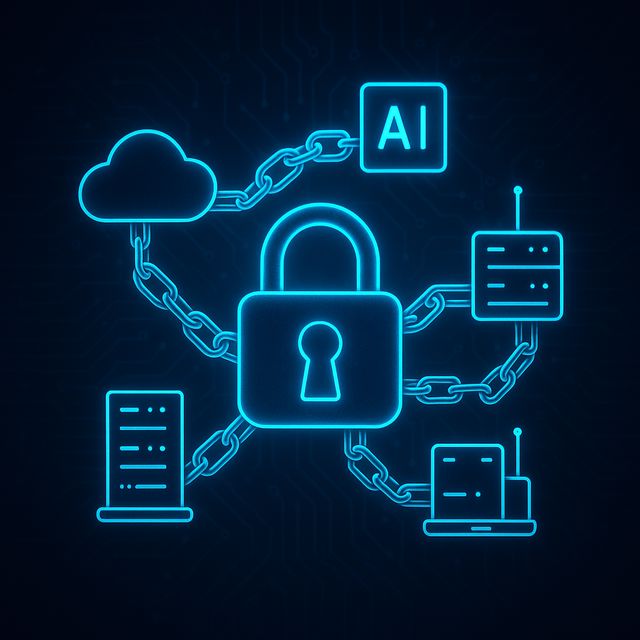
The Expanding Attack Surface
A modern enterprise’s attack surface is no longer limited to its own perimeter.
It includes every open-source library, every unmanaged switch in a vendor’s facility, every AI model trained on third-party data, and every server firmware update pulled from a global repository.
To illustrate the depth of the problem, the table below summarizes key indicators from global research on software supply chain breaches:
| Metric | Data (2024) | Implication for CISOs & DPOs |
|---|---|---|
| Average cost of a supply chain attack | $4.63 million | Risk extends beyond direct compromise affects continuity and trust |
| Average time to detect and contain | 294 days | Requires real-time visibility and automation (DevSecOps integration) |
| Annual increase in attack frequency | 742% | Traditional risk models no longer sufficient |
| % of data breaches from supply chain origins | 12% | Supply chain now a primary attack vector |
| CEOs prioritizing ecosystem protection | 76% | Security now a board-level responsibility |
Data compiled from verified global cybersecurity studies, including 2024industry research on software supply chain breaches and executive risk perception reports.
Executives can no longer view supply chain risk as a technical issue it is a governance, compliance, and reputational concern.
The dependency pyramid behind every application may look solid, but one compromised base layer can collapse the entire structure.
This reality affects not only software suppliers but also hardware and networking ecosystems. An unpatched firmware, a vulnerable unmanaged switch, or an outdated server image can serve as the breach point that disrupts operations across multiple partners.
Building a Secure Software Supply Chain
Securing the software supply chain requires an understanding of its lifecycle.
Every software product passes through four key stages Create, Build, Deploy, and Run each with unique risks.
Create Phase
Developers produce and review code, often integrating external dependencies. This stage demands strict controls:
- Enforce secure coding standards.
- Perform peer reviews and continuous scanning (SAST, DAST, SCA).
- Verify open-source authenticity through signed commits and provenance checks.
- Maintain SBOMs (Software Bill of Materials) to document every component.
Build Phase
Here, source code becomes executable artifacts. The risks multiply if build environments are misconfigured or shared across teams.
To mitigate:
- Use hardened CI/CD pipelines with minimal privileges.
- Generate attestations for every build (aligned with SLSA principles).
- Store artifacts in isolated repositories with automated vulnerability scans.
- Integrate continuous validation each commit should trigger both functional and security tests.
Deploy Phase
At this stage, artifacts move from development to production.
- Implement GitOps and Infrastructure-as-Code for consistent, verifiable deployments.
- Validate container images and SBOM integrity before production rollout.
- Automate security gates in CI/CD pipelines to detect tampered artifacts.
Run Phase
Applications execute in hybrid or cloud environments.
- Continuously monitor runtime behavior using AI-driven anomaly detection.
- Apply network segmentation to isolate workloads, in cluding unmanaged switches or IoT gateways.
- Ensure systems are patched with the latest firmware and server-level updates.
- Integrate endpoint telemetry with DevSecOps dashboards for unified visibility.
This cyclical process Create, Build, Deploy, Run—should be continuously validated. Each iteration builds traceability and trust into the organization’s development DNA.
Strategic Frameworks and Best Practices
Executives seeking resilience must align their organizations with recognized frameworks designed for software supply chain security.
While many standards exist, the following provide a pragmatic path from policy to execution.
NIST Secure Development & Risk Frameworks
- SP 800-53 & 800-37 establish the foundation for security and privacy controls.
- SP 800-161 extends these into supply chain risk management (SCRM).
- SP 800-218 (SSDF) provides a developer-centric playbook for secure coding.
- SP 800-204D focuses on integrating DevSecOps security into CI/CD pipelines.
Together, these frameworks promote continuous validation, risk-based controls, and traceable software lineage.
SLSA (Supply-chain Levels for Software Artifacts)
A progressive framework that defines four maturity levels for build integrity.
Each level adds stronger provenance guarantees—from basic metadata to fully verified builds ensuring confidence in every distributed artifact.
SBOM and VEX Integration
An SBOM offers transparency, listing every component within an application, while VEX (Vulnerability Exploitability eXchange) communicates whether known vulnerabilities actually affect a given artifact.
Together, they reduce false positives and accelerate vulnerability response.
ISO 27001 and ISO 27036
While ISO 27001 establishes broad information security management requirements, ISO 27036 focuses on supplier relationship security.
Organizations aligning supply chain controls with these standards can ensure both compliance and operational trust.
DevSecOps Enablement
Modern supply chain resilience depends on automation. Embedding DevSecOps principles secure coding, automated scanning, continuous validation, and least-privilege enforcementtransforms security from a bottleneck into an enabler.
True supply chain security isn’t about blocking innovation it’s about building secure velocity.
Practical Risk Mitigation and Continuity Planning
Supply chain security is more than compliance it’s an evolving discipline.
The following strategies synthesize best practices from global standards and real-world incidents:
- Visibility | Map all suppliers, dependencies, and infrastructure touchpoints.
- Verification | Require attestations and SBOMs from every partner and artifact.
- Automation | Integrate AI-driven vulnerability scanning and behavioral analytics.
- Segmentation | Isolate network layers and restrict lateral movement, especially across unmanaged switches and legacy devices.
- Redundancy | Maintain alternate suppliers and cloud zones for continuity.
- Awareness | Train developers, procurement teams, and executives in SCRM awareness.
- Response | Implement structured incident management plans with clear supplier escalation paths.
Resilience must be measurable.
Executives should monitor key performance indicators (KPIs) such as:
- Percentage of suppliers assessed annually.
- Mean time to remediation (MTTR) for supply chain incidents.
- Coverage of SBOM and VEX documentation across applications.
- Frequency of security validation in CI/CD pipelines.
From Compliance to Leadership
Regulations like the EU Cyber Resilience Act and NIS2 Directive mark a turning point.
What was once “best practice” is now a baseline expectation.
Executives must evolve from compliance checklists to proactive resilience management.
Leadership in this domain means fostering trust:
- Between internal teams (DevSecOps and IT operations).
- Between organizations and suppliers.
- Between technology providers and customers.
A secure supply chain is not a side project it’s a statement of business maturity.
From AI security to unmanaged switches and hybrid servers, each asset and dependency forms part of a larger trust network.
By building visibility, accountability, and automation into this network, organizations ensure both compliance and continuity.

It’s the practice of protecting every component people, code, infrastructure, and processes involved in creating and maintaining digital systems.
They exploit trusted relationships and legitimate processes, often blending into normal software updates.
By embedding security checks within every build and deployment step, DevSecOps automates verification and reduces human error.
A Software Bill of Materials lists every component within an application, providing visibility to identify vulnerabilities quickly.
By adopting lightweight frameworks like SLSA and automating dependency scanning with open-source tools.
Yes Annex A.15 and A.17 address supplier security and continuity, forming the foundation for broader SCRM initiatives.
References
Supply chain security guidance – ncsc.gov.uk
Supply chain security collection – npsa.gov.uk
Good Practices for Supply Chain Cybersecurity – enisa.europa.eu