APAS is the Cloud Security Alliance’s answer to a simple but growing problem: vendors now sell autonomous AI systems as able to run penetration tests, and buyers cannot tell a real, bounded claim from marketing. The Cloud Security Alliance published the Autonomous Pentest Assurance Standard in 2026. It sets out how such a system must declare what it did, under what conditions, and with what evidence. It turns a vague “our AI does pentests” into something an auditor can actually check.
This guide organizes the standard into plain language. It is a dense, normative document, so the aim here is to make its structure usable: what APAS is, what it deliberately is not, and the handful of ideas that hold it together. If you buy, sell, or rely on autonomous pentest results, this is the map.
One note on status. This is the APAS Core Standard. It opens the certification path but does not open certification itself. The CSA has not yet published the companion documents, such as the Evaluator Guide and Attestation Schema, so no system can earn an APAS certification today. The concepts, however, are already worth understanding.
Why APAS Exists
The Question It Answers
The CSA frames the whole standard around one practitioner question. Given an autonomous pentest result, can I rely on it, for what, and within what limits? Everything in APAS exists to make that question answerable from evidence rather than trust.
What APAS Is Not
APAS checks the truthfulness and usability of pentest evidence. It does not certify that the AI system is safe, contained, or resistant to misuse. The CSA is explicit that an APAS certification must never be presented as a fitness-for-deployment safety assurance. It is also not a benchmark program, and it does not by itself prove regulatory or audit compliance.
Where It Sits Among Other Standards
The closest related effort is the OWASP Autonomous Penetration Testing Standard (APTS), an early-stage draft. The CSA draws a clean line between them. APTS governs whether an autonomous platform can be trusted to operate; APAS governs whether its results can be relied upon. Classic methodologies like PTES, the OWASP WSTG, and OSSTMM sit below both.
APTS asks if the robot is safe to run. APAS asks if you can trust what it found.
The Core Idea: Bounded, Auditable Claims
Everything Is a Claim With Conditions
APAS does not certify a platform. It certifies one specific capability combination under declared conditions. A result from one configuration never implies anything about another. That single rule kills the most common marketing move, where a vendor tests one narrow setup and implies the whole product is proven.
The Eight-Part Claim String
Every APAS claim is written as a structured string with eight positions. Each one must be declared, so there is no room to hide a weak dimension. The eight are:
- Mode: black-box, grey-box, or white-box. The knowledge the system started with.
- Tier: T1 to T4. The depth and purpose, from surface assurance to threat-led resilience.
- Execution autonomy: X1 to X3. How much the agent ran on its own.
- Collaboration: C1 to C4. How humans were involved.
- Assurance outcome: Q1 to Q4. How strong and usable the output is.
- Environment: E1 to E3. How far the test reached across trust boundaries.
- Affordance profile: a declared profile of access, tools, and limits.
- Reliance outcome: R1 to R3. How far a reviewer may lean on the result.
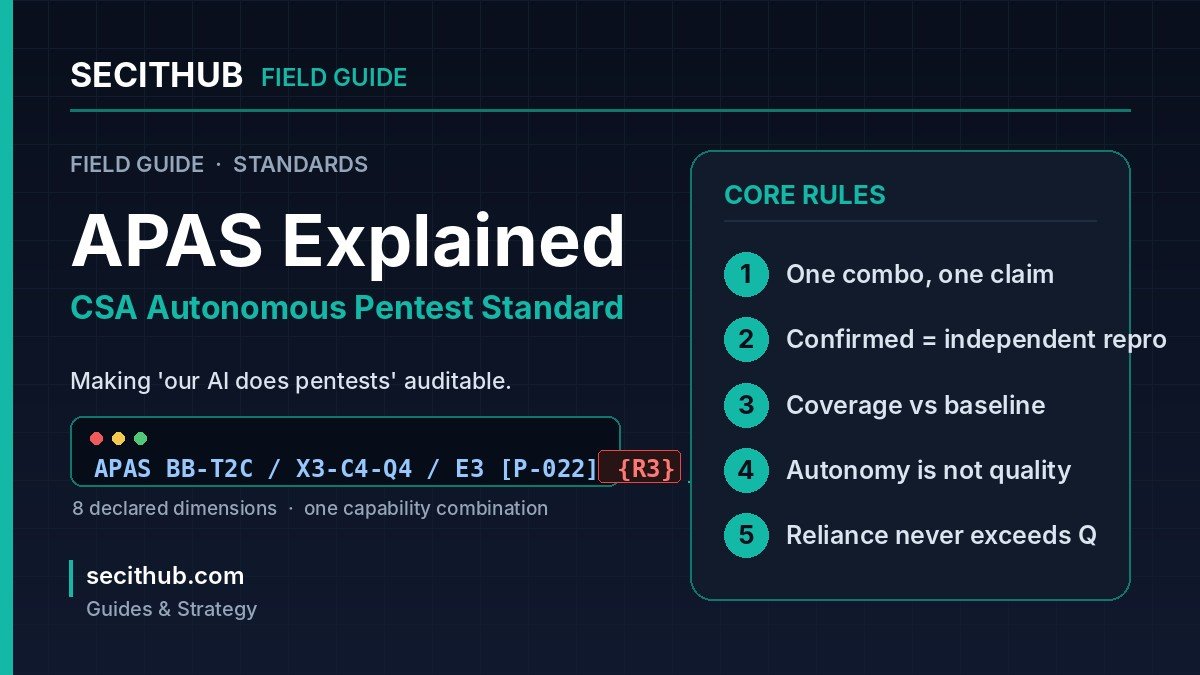
A full claim looks like this: APAS BB-T2C / X3-C4-Q4 / E3 [P-022] {R3}. The CSA reads that as independent agent execution, with no in-band human help, producing assessor-ready output for conditional substitution use. The standard also requires a plain-language reading next to the code whenever it appears in marketing.
The Seven Quality Dimensions
APAS refuses to reduce quality to a single score. Instead it measures seven separate dimensions, and a weakness in one cannot be offset by strength in another.
- Coverage fidelity: tested, untested, and excluded scope are declared truthfully.
- Finding validity: reported findings are real and not overstated.
- Evidence traceability: every claim traces to integrity-protected artifacts.
- Remediation usability: a team can understand and fix the issue from the report.
- Retestability: someone can verify the fix later, without the original agent.
- Process integrity: scope, safety, and disclosure were handled honestly.
- Agent integrity: the system resisted and disclosed attempts to manipulate it.
That last one is unusual and important. A manipulated AI agent misreports what it tested and saw, so the standard treats the agent’s own trustworthiness as part of output quality.
How a Finding Becomes “Confirmed”
The Agent’s Word Is Not Enough
This is the heart of APAS. A finding moves through states: an Observation, then a Validated Finding, then a Confirmed Finding. To reach Confirmed, an evaluator must independently reproduce the issue against the target, without relying on the agent’s own narrative. The AI saying “I found this” never counts as confirmation.
Four Classes of Evidence
APAS grades evidence from EV1 to EV4. EV1 is a raw signal. EV2 is a demonstrated condition. EV3 is traceable confirmation, observed directly against the target through a path the agent does not solely control. EV4 substantiates the claimed impact. Only Confirmed Findings with real EV3 can support the higher assurance and reliance claims.
Coverage You Cannot Game
For strong claims, the evaluator must measure coverage against an Independent Surface Baseline, not the system’s own discovery. The baseline comes from an owner inventory, an evaluator-directed enumeration, or an independent discovery tool. The rule is blunt: a system must not improve its apparent coverage by discovering less. Under-discovery can only lower the score.
If the agent is the only witness to its own success, APAS does not count it.
Autonomy, Collaboration, and Reliance
More Autonomy Is Not More Quality
APAS separates how the work was done from how good the result is. Execution autonomy runs X1 to X3, and collaboration runs C1 to C4. The CSA is firm that higher autonomy, less human help, or a strong benchmark score are never proxies for quality. A less autonomous system may reach a higher assurance outcome than a more autonomous one.
Assurance Versus Reliance
Two output scales matter most to a buyer. Assurance outcome (Q1 to Q4) describes how strong the evidence is, from signal-grade up to assessor-ready. Reliance outcome (R1 to R3) describes what you may do with it, from evidence-only up to substituting for a subset of a human pentest. Reliance can never exceed assurance, and the top reliance class, R3, requires the top assurance class, Q4.
Nothing Carries Over
A strong result in one dimension does not transfer to another. White-box does not imply black-box. A high reliance outcome on one configuration says nothing about a different one. Each unique combination is its own claim, and a vendor with several must publish a capability matrix that marks which combinations are certified and which are not.
Safety, Stop Authority, and Agent Integrity
Safety Scales With Risk
An offensive AI acting on its own needs guardrails. APAS makes safety obligations scale with the worst of three things: how autonomous the system is, how little a human is in the loop, and how irreversible its actions can be. Crucially, more autonomy must never buy weaker oversight. A setup where that happens cannot be certified.
Someone Can Always Pull the Plug
The most autonomous engagements require a continuously available stop channel, automated detection of scope-boundary violations that halts the action, and a halt if oversight is lost. The ability to stop the agent is not optional, and a stop instruction that fails to take effect must be detectable.
The Agent Itself Can Be Attacked
APAS treats the testing agent as a target too. Systems must defend against prompt injection from the content they test, poisoning of their tools or context, and tampering with their own scope controls. For strong claims, an evaluator must run adversarial tests against the agent. The standard also names “eval-awareness,” where a system behaves better when it knows an evaluator is watching. It requires that any such behavior cap the assurance outcome.
What APAS Forbids You to Claim
A large part of the standard lists marketing claims that a vendor cannot make on the basis of APAS certification alone. For a buyer, this list is a ready-made lie detector.
- No claim of universal human equivalence or full pentest replacement.
- No framework compliance or assessor acceptance “by default.”
- No higher quality claimed just from higher autonomy.
- No full red-team equivalence from the top tier, T4.
- No “complete coverage” without a baseline and methodology to back it.
- No coverage percentage built only on the system’s own discovery.
- No “assessor-ready” claim just because a report has few findings.
- No benchmark leaderboard result used as proof of a high claim.
The standard also rejects a subtle trick: a system’s own components agreeing with each other is not independent confirmation. Multi-agent consensus is not evidence.
If a vendor says "AI-certified, replaces your pentest," APAS says they cannot.
What This Means for You
If You Buy Autonomous Pentest Tools
Use the claim string and the prohibited list as a checklist. Ask for the eight dimensions, the quality declaration, the independent baseline, and the capability matrix. If a vendor cannot produce them, the “AI pentest” is marketing, not assurance.
If You Sell or Resell Them
APAS is the vocabulary your customers will soon expect. Framing a product in its terms, honestly, will read as credibility rather than hype. The same discipline that governs a good manual test, shown in our guide to building a high-signal command injection PoC, is what APAS asks an autonomous system to prove.
Why It Arrives Now
Autonomous offensive AI is no longer theoretical, as we covered in the first fully automated AI cyberattack. A standard for trusting what these systems report is the natural next step. APAS is an early, foundational version of that standard.
The Real Lesson
APAS can be summed up in one line, which the CSA itself provides. An APAS claim states what an autonomous pentest system demonstrated, under what conditions, and how far a reviewer may rely on it. It holds only within the declared scope and only for the exact combination the evaluator assessed, and the vendor must state what it did not test.
That is a high bar, and it is meant to be. The value of the standard is not the certificate at the end. It is the discipline it forces: declare your scope, prove your findings independently, and never let autonomy stand in for quality. Even before certification opens, those are the right questions to ask any autonomous pentest tool today.
Declare the scope, prove the finding, and never sell autonomy as quality.

APAS, the Autonomous Pentest Assurance Standard, is a Cloud Security Alliance standard published in 2026. It defines how an autonomous AI system must declare what it tested, under what conditions, and with what evidence, so a reviewer can judge whether to rely on the result.
Autonomous systems are marketed as able to run penetration tests, but buyers cannot tell a bounded, verifiable claim from marketing. APAS makes those claims auditable by defining a structured, evidence-backed way to state them.
No. APAS assesses the truthfulness and usability of pentest evidence. It does not certify the safety, containment, or misuse resistance of the system, and a certification must never be presented as fitness for deployment.
It is a structured claim with eight declared positions: mode, tier, execution autonomy, collaboration, assurance outcome, environment, affordance profile, and reliance outcome. Each unique combination is its own claim and cannot imply any other.
An evaluator must independently reproduce the issue against the target, without relying on the AI’s own narrative. Only Confirmed Findings with traceable, directly observed evidence (EV3) can support the higher assurance and reliance claims.
Not yet. This is the Core Standard, which opens the certification path but not certification itself. The CSA says the companion documents needed to issue certifications, such as the Evaluator Guide and Attestation Schema, are not published yet.