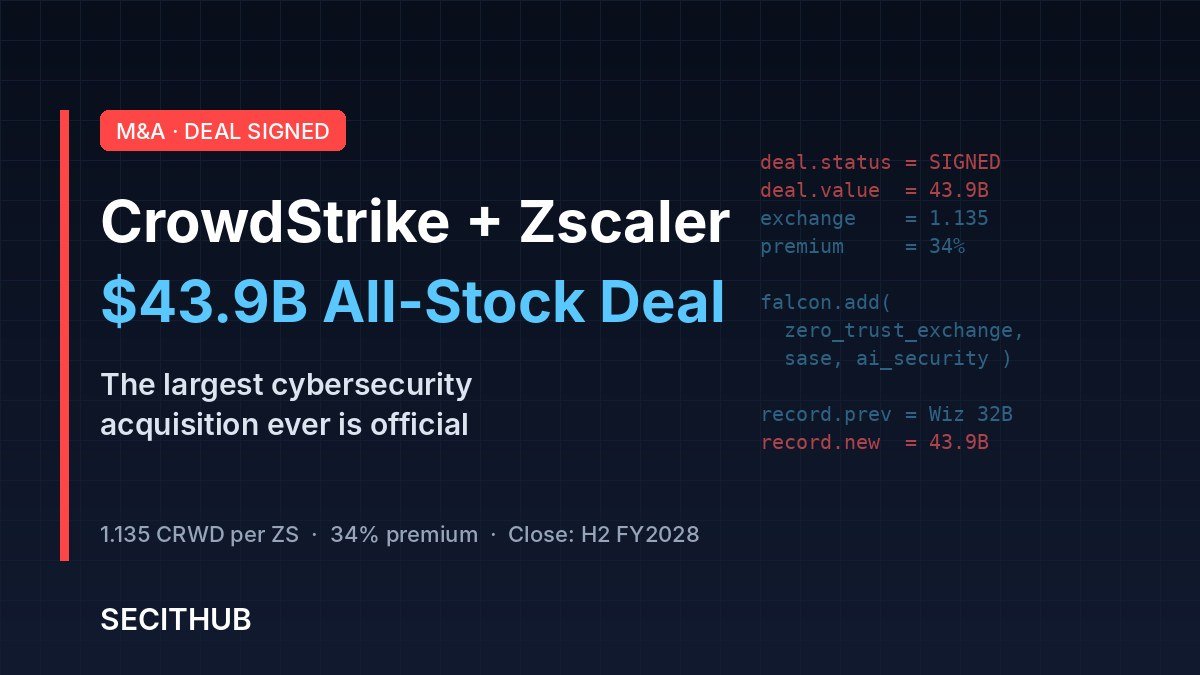
CrowdStrike acquires Zscaler, and this time it is official. On 23 November 2026, the two companies announced a definitive agreement for an all-stock deal that values Zscaler at about $43.9 billion. Three days earlier, the deal was only a rumor. Now it has signed terms, board approval and a timeline. It is also the largest acquisition in cybersecurity history.
We covered the first reports of the talks and why CrowdStrike wants Zscaler. This article focuses on what is new: the signed terms, the product plans and what customers should do next.
The Deal Terms: How CrowdStrike Acquires Zscaler
Price and Structure
Zscaler shareholders will receive 1.135 CrowdStrike shares for each Zscaler share. According to the official release, that implies about $260.41 per share. It is a premium of roughly 34% over Zscaler’s close on 20 November. No cash changes hands. After closing, CrowdStrike shareholders will own about 84.1% of the combined company, and Zscaler shareholders about 15.9%.
Approvals Already in Place
Both boards approved the deal unanimously. Jay Chaudhry, Zscaler’s founder and CEO, and his affiliates hold about 34% of Zscaler’s shares. They signed voting agreements that support the deal. That gives the vote a strong head start.
Who Leads Zscaler
Chaudhry will keep leading the Zscaler business after the deal closes. He will also join CrowdStrike’s board. George Kurtz stays CrowdStrike’s CEO. Until closing, the two companies will operate independently.
On Friday it was a rumor. On Monday it was a signature.
What Changed Since the Talks Were Reported
- A signed, board-approved definitive agreement
- About $43.9 billion, all in CrowdStrike stock
- 1.135 shares per Zscaler share, a 34% premium
- Close expected in the second half of CrowdStrike’s fiscal 2028
- How regulators in the US and EU will respond
- Which overlapping products lead and which fade
- Whether Zscaler moves to a single Falcon agent
- Pricing once bundles arrive under Falcon Flex
A New Record
Google’s $32 billion purchase of Wiz, closed in March 2026, held the record until now. At $43.9 billion, this deal beats it by about $11.9 billion. It also lands just three days after Bloomberg and Reuters first reported the talks.
Announced With Earnings
CrowdStrike paired the news with its fiscal third-quarter results. It reported a record $419 million in net new annual recurring revenue (ARR) and ending ARR of $6.26 billion. Zscaler reported its own quarter the same day, with revenue up 20% to $949.3 million. Together, the companies expect to start with more than $10 billion in combined ARR at closing.
How the Market Reacted
According to Reuters, Zscaler shares rose more than 13% in premarket trading. CrowdStrike shares fell about 5%. Investors often push down the buyer’s stock in a large all-stock deal, since new shares dilute existing holders.
The Product Plan: Zscaler Inside Falcon
Zero Trust Becomes Part of Falcon
After closing, Zscaler’s Zero Trust SASE, security for AI and data protection will be offered as part of the Falcon platform. The plan pairs the Falcon sensor on devices and workloads with the Zero Trust Exchange on connections. Falcon Next-Gen SIEM would then hold device and network data in one place. The Zero Trust Exchange alone handles more than 750 billion transactions a day, according to the release.
One Contract Through Falcon Flex
Zscaler products will move onto Falcon Flex, CrowdStrike’s flexible licensing model. Customers of either company could then add the other’s products under one contract. CrowdStrike also plans to sell Zscaler through its integrators, resellers, distributors and cloud marketplaces. It sees room to grow with smaller companies and MSSPs.
What the Release Does Not Say
The release does not promise to fold Zscaler into a single Falcon agent. It also does not say what happens where the two overlap, such as cloud security and managed detection. Zscaler owns Red Canary, while CrowdStrike runs its own managed services. Expect those answers to come later, not on day one.
One contract is easy to promise. One platform takes years to build.
Why the Numbers Matter
8,000 New Customers to Cross-Sell
About 8,000 Zscaler customers do not yet use CrowdStrike. The two already share more than 2,000 customers and 16 integrations. Zscaler also protects about half of the Fortune 500, according to the release. That is a large base for cross-selling.
Synergy Targets
CrowdStrike targets about $1 billion in annual revenue synergies within 30 months of closing. It also targets $500 million in annual cost synergies within 18 to 24 months. Those savings are expected to come mainly from data center infrastructure, vendors and operations. Cost cuts of that size usually mean overlap gets removed. Customers should watch which tools and teams that affects.
A Long Road to Close
The companies expect the deal to close in the second half of CrowdStrike’s fiscal year 2028. Based on CrowdStrike’s fiscal calendar, that points to roughly August 2027 to January 2028. Closing still needs Zscaler shareholder approval and regulatory clearance. For comparison, Google’s Wiz deal took about a year from announcement to close.
What Customers Should Do Now
Nothing changes until the deal closes, and that may take a year or more. Use the time well. Start with these steps:
- Do not rush renewals. A signed deal is not a reason to lock in long terms this quarter. Negotiate with the timeline in mind.
- Ask for roadmap answers in writing. Ask both vendors which products they will support and for how long, especially where they overlap.
- Check change-of-control terms. Review your Zscaler and CrowdStrike contracts for clauses that apply after an acquisition.
- Map your integrations. List every link between Falcon, Zscaler, your SIEM, identity provider and SOAR tools.
- Watch Falcon Flex pricing. Bundles can save money, but they also make it harder to leave one layer later.
- Keep an exit option. Make sure you could replace endpoint or network security without rebuilding the whole stack.
- Brief your leadership. Explain what changes now (nothing), what may change after close, and when you will decide.
CrowdStrike now has a path to cover endpoint, identity, cloud and network access under one brand. That puts it in direct competition with Palo Alto Networks at a new scale. For buyers, it means more integration and fewer independent choices. To compare the remaining options in each category, see our Cybersecurity Vendor Landscape.
The deal is signed. Your exit strategy should be too.
Yes. On 23 November 2026, CrowdStrike and Zscaler signed a definitive agreement under which CrowdStrike will acquire Zscaler in an all-stock deal valued at about $43.9 billion.
About $43.9 billion in enterprise value. Zscaler shareholders get 1.135 CrowdStrike shares per share, about $260.41 each, a 34% premium to the 20 November close.
The companies expect it to close in the second half of CrowdStrike’s fiscal year 2028, subject to Zscaler shareholder approval and regulatory approvals.
Yes. At about $43.9 billion, it is larger than Google’s $32 billion acquisition of Wiz, which closed in March 2026.
After closing, Zscaler’s Zero Trust SASE, security for AI and data protection will be offered as part of the CrowdStrike Falcon platform and through Falcon Flex. Jay Chaudhry will keep leading the Zscaler business.
No immediate change is needed, since both companies operate independently until closing. Customers should avoid rushed renewals, review contracts and ask for roadmap commitments in writing.
Sources
CrowdStrike: CrowdStrike to Acquire Zscaler, Bringing Network Security and Zero Trust to the Falcon Platform
CrowdStrike: Third Quarter Fiscal Year 2027 Financial Results
Zscaler: First Quarter Fiscal Year 2027 Financial Results
Reuters via Investing.com: CrowdStrike bets on network security with $43.9 billion Zscaler deal