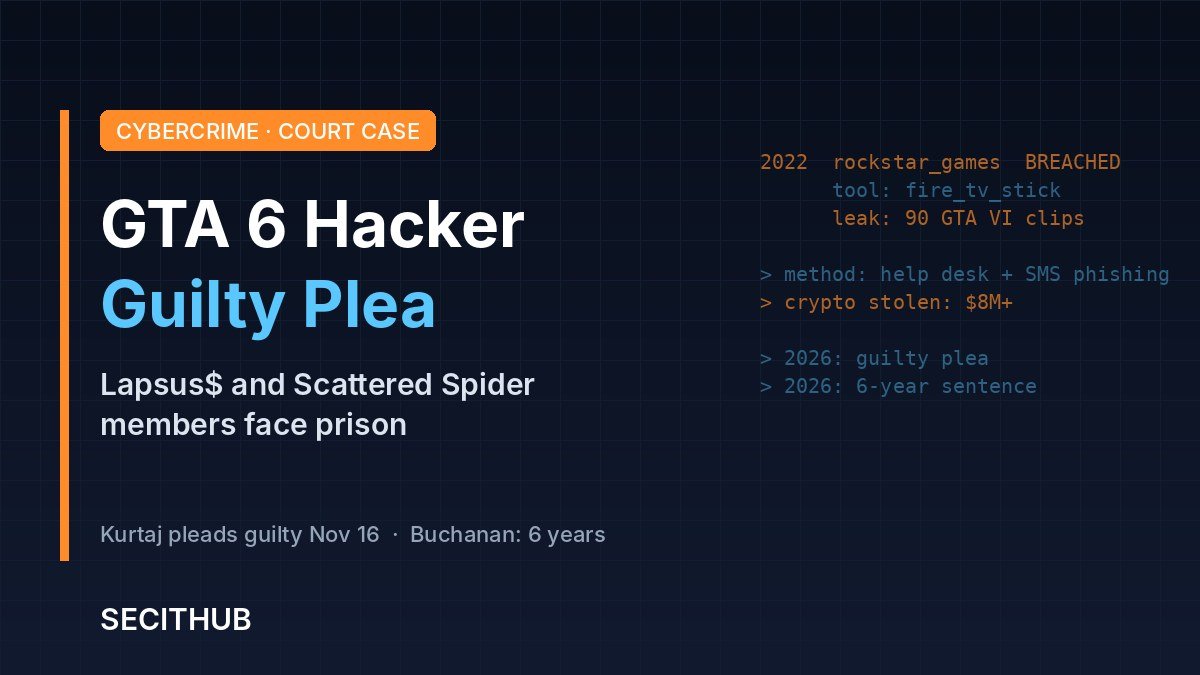
The GTA 6 hacker case has reached its final chapter just as the game itself hits shelves. On November 16, 2026, Arion Kurtaj, now 21, pleaded guilty at Woolwich Crown Court in London to the 2022 hack of Rockstar Games and a string of other attacks he carried out as a teenager. Meanwhile, TechCrunch reports that Tyler Buchanan, a 24-year-old from Dundee, has received a six-year US sentence for a phishing scheme that stole millions in cryptocurrency.
Both men belonged to the same loose world of young hackers behind Lapsus$, 0ktapus and later Scattered Spider. Their crimes did not rely on advanced malware. They relied on phone calls, fake login pages and help desks that trusted the wrong caller. That is the part every security team should study.
The GTA 6 Hacker Pleads Guilty
Kurtaj’s case is one of the strangest in recent cybercrime history.
The Rockstar breach
In September 2022, Kurtaj broke into Rockstar Games and stole internal data, including about 90 clips of early Grand Theft Auto VI footage. He leaked the clips and tried to blackmail the company. Rockstar refused to negotiate and later said the hack cost it about $5 million to recover from.
Hacking from a hotel room
At the time, Kurtaj was on bail for earlier hacks and staying in a hotel under police protection. He had no laptop. He used an Amazon Fire TV stick, a phone and the hotel TV to break into Rockstar’s systems.
A long road to a guilty plea
In 2023, a jury found that Kurtaj carried out the attacks, and a court ordered him held in a secure hospital. In 2026, doctors found him fit to stand trial, and he moved to prison ahead of a retrial. His plea this week covers attacks on Rockstar Games, BT and EE, Revolut and Uber. He will be sentenced at a later hearing.
A Fire TV stick and a hotel TV were enough to breach one of the world's biggest game studios.
The Scattered Spider Sentence
Buchanan’s case shows the same playbook at a larger, more profitable scale.
Fake help desks, real losses
Buchanan and his co-conspirators sent waves of text messages and made calls that posed as company IT teams. Employees entered their credentials on fake login pages, and the group used them to break into corporate networks. Prosecutors say the crew then stole at least $8 million in cryptocurrency from victims.
From arrest to prison
Spanish police arrested Buchanan at Palma airport in June 2024. He was sent to the United States in April 2025 and pleaded guilty in April 2026 to wire fraud conspiracy and aggravated identity theft. He is the last of five defendants sentenced in the case. A co-defendant, Noah Urban, received ten years in 2025.
A group running out of members
Law enforcement has steadily taken apart the network. In July 2026, a UK court jailed two other Scattered Spider members over the 2024 attack on Transport for London. Authorities say the arrests have disrupted the group’s core operations, though copycats still use its name.
What the GTA 6 Hacker Case Teaches Defenders
Researchers nicknamed these crews “advanced persistent teenagers.” They hit Microsoft, NVIDIA, Uber, MGM Resorts and dozens of others without nation-state tools.
People are the entry point
These groups rarely needed a software exploit. They called help desks, sent SMS lures and spammed users with MFA prompts until someone approved one. The weakest link was a busy employee, not a server. Our analysis of the human attack surface explains why this keeps working.
Collaboration tools are the new crown jewels
Kurtaj reached Rockstar through its internal messaging platform. Once inside Slack, Teams or similar tools, attackers can read secrets, find admin contacts and impersonate staff. Many companies still protect these tools less carefully than email.
Age is not a defense signal
Teenagers with free time, social skills and online forums caused major damage across these campaigns. Defenders should not dismiss “kids” as low-risk. Their methods scale because they target processes that every company shares.
AI makes the old tricks stronger
The calls that fooled help desks in 2022 relied on confidence and a good script. Today, attackers can add cloned voices, fluent messages in any language and fake profiles built in minutes. That makes caller ID and “sounds like the CEO” useless as proof of identity. Verification has to rely on something the attacker cannot copy.
How to Stop Help Desk and Phishing Attacks
The fixes are well known, and most are cheaper than a single breach.
- Verify every reset request. Require call-backs to known numbers, manager approval or in-person checks before help desks reset passwords or MFA.
- Move to phishing-resistant MFA. Use passkeys or FIDO2 security keys instead of SMS codes and push prompts.
- Stop MFA fatigue. Turn on number matching and limit repeated prompts.
- Protect phone numbers. Ask carriers for SIM-swap locks on executive and admin lines.
- Lock down chat platforms. Enforce SSO, monitor new sessions and keep secrets out of messages.
- Train with real scenarios. Run fake help desk calls and SMS lures, not just email tests. Our identity security guide covers the controls behind these steps.
Your help desk is a security control. Treat every call like it could be the breach.
The GTA 6 hacker case and the Scattered Spider sentence close a chapter in one of the most damaging cybercrime waves of the decade. Courts are catching up, and the core members now face prison.
But the techniques live on. New crews, and now AI voice tools, make help desk fraud and phishing easier than ever. The real lesson is not about one teenager in a hotel room. It is about how easily trusted processes can be turned against the companies that run them.
Want to see how another group is using leak sites to pressure big brands?
Read our analysis: The Gentlemen Ransomware Claims NVIDIA.
Harden the human layer before the next caller asks for a password reset.

Arion Kurtaj, a Lapsus$ member from Oxford who hacked Rockstar Games in 2022 and leaked early Grand Theft Auto VI footage. He pleaded guilty on November 16, 2026.
While on bail and staying in a hotel under police protection, he used an Amazon Fire TV stick, a phone and the hotel TV to access Rockstar’s internal systems.
Attacks on Rockstar Games, BT and EE, Revolut and Uber, carried out when he was a teenager. He will be sentenced at a later hearing.
A 24-year-old from Dundee, Scotland, linked to Scattered Spider. He was sentenced to six years in the US for a phishing scheme that stole millions in cryptocurrency.
A loose group of mostly young English-speaking hackers known for help desk social engineering and SMS phishing. It overlaps with Lapsus$ and 0ktapus.
Verify reset requests through known channels, use phishing-resistant MFA, block MFA fatigue, protect phone numbers from SIM swaps and train staff with realistic call scenarios.
Sources
British hackers face prison for GTA 6 data breach and crypto thefts – TechCrunch
British hacker tied to Scattered Spider pleads guilty – The Record