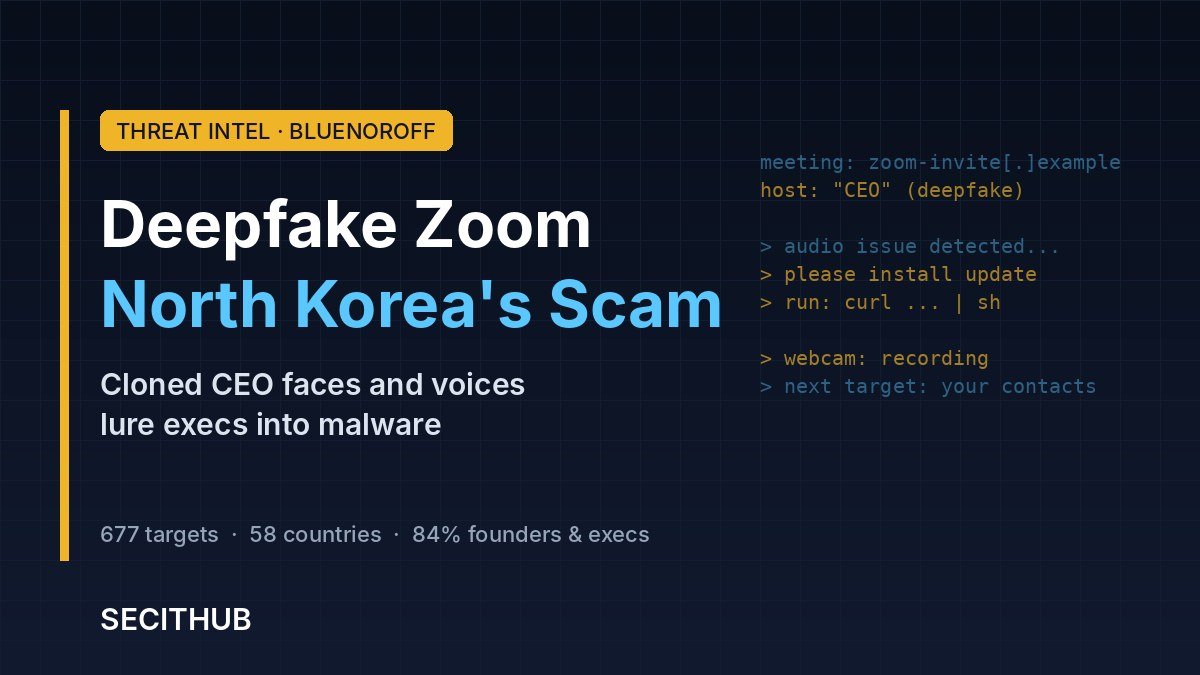
A North Korean deepfake Zoom scam is spreading faster than ever. New research from Arctic Wolf Labs shows the BlueNoroff group has targeted 677 people in 58 countries by cloning the faces and voices of real executives and using them in fake video calls. About 84% of the targets are founders or senior leaders in tech, Web3 and venture capital. Days earlier, the FBI issued its own alert on the same scheme, which it calls “FaceStealer.”
The scam does not break any software. It breaks trust in the one thing many people still treat as proof: a live face on a video call. If your executives speak at conferences or appear on YouTube, attackers already have the raw material to impersonate them.
How the Deepfake Zoom Scam Works
The campaign follows a clear, repeatable playbook.
Step 1: Harvest public footage
The attackers collect interviews, podcasts and conference talks of founders and CEOs. Public speakers give them hours of clean video and audio to work with.
Step 2: Clone the executive
Arctic Wolf says the group uses commercial AI tools to clone faces and voices. According to the researchers, the results can no longer be told apart from real webcam video by simple visual inspection.
Step 3: Book a fake meeting
Victims receive an invite to what looks like a Zoom or Microsoft Teams call with a known partner or investor. In earlier cases, the first contact came through a compromised Telegram account belonging to a real executive. The meeting link leads to a look-alike site.
Step 4: Stage a “technical problem”
During the call, the fake executive reports audio or video trouble. The victim is told to install an “update,” a plugin or a fix, or to paste a command into a terminal. That step installs the malware.
Step 5: Turn victims into bait
Here is the most dangerous twist. The attackers quietly record the victim’s own webcam during the call. They then use that footage to impersonate the victim to their contacts. Each new victim becomes the lure for the next one.
Every victim's face becomes the next victim's bait.
Who Is Behind It and Why It Is Growing
BlueNoroff is a financial theft unit linked to North Korea’s Lazarus Group. Its main goal is stealing cryptocurrency to fund the regime.
The numbers keep climbing
In April 2026, the campaign targeted just over 400 people in 20 countries. Today it reaches 677 targets in 58 countries. Arctic Wolf tracked 98 malicious domains, most of them newly registered. Analysts also flagged 349 videos as likely manipulated.
The FBI is watching
On November 12, the FBI published a FLASH alert on “FaceStealer,” describing fake Zoom, Teams and Google Meet calls run by North Korean operators. The alert pulls together months of vendor research into one law enforcement account of the full attack chain.
AI multiplies, it does not reinvent
Arctic Wolf makes an important point. AI acts as a production multiplier for the group, but it has not changed how the intrusion works. The victim still has to run something. That means the defense still works if people follow it.
A huge prize
US officials say North Korea stole more than $2 billion in cryptocurrency in 2025. A single compromised founder or fund partner can open the door to wallets, treasury keys and investor funds. That makes executives in crypto and venture capital some of the most valuable targets in the world.
Why Deepfake Calls Work So Well
These attacks exploit habits that most professionals never question.
Video feels like proof
Many security policies tell staff to “verify by video” when an email looks odd. Deepfakes turn that advice into a weakness. A familiar face now proves nothing on its own.
Tech problems are normal
Everyone has joined a call with broken audio. A request to install a quick fix sounds routine, especially from a busy executive. Attackers rely on that politeness and urgency, much like the help desk scams used by Scattered Spider.
Public profiles feed the machine
Founders and investors are expected to be visible. They speak on panels, record podcasts and post videos to build their brands. Every clip gives attackers more material for a convincing clone. Executives do not need to disappear online, but security teams should know which leaders have the largest public footprint and brief them first.
Detection tools lag behind
Deepfake detection products exist, but quality improves faster than detectors can keep up. Relying on software to spot a fake face is a losing race. Process controls, such as call-back rules and install bans, work no matter how good the fake looks.
How to Protect Your Team From Deepfake Calls
Most of these steps cost nothing but discipline.
- Never install anything during a call. No legitimate Zoom or Teams meeting requires a plugin, update or terminal command from a participant.
- Use only official apps and links. Join meetings from the real Zoom, Teams or Meet app, and check the domain before you click.
- Verify through a second channel. Confirm unusual meetings or requests with a call to a known number or a message on a separate platform.
- Agree on code words. Executives and finance teams can use private phrases to confirm identity on sensitive calls.
- Lock down endpoints. Block unsigned software and script execution on executive laptops, and monitor macOS as closely as Windows.
- Train leadership first. Executives are the main targets, so brief them directly. Our guide to the human attack surface shows how to start.
If a call asks you to install something, end the call.
The deepfake Zoom scam shows how quickly AI has erased the line between real and fake on screen. A face and a voice are no longer enough to prove who you are talking to.
The good news is that the final step still depends on the victim. Organizations that set one firm rule, never install or run anything because someone on a call asked, can stop this campaign cold.
Want to see how AI is changing the speed of both attack and defense?
Read our analysis: GPT-6 Cyber Finds 35 Apple Flaws.
Trust the process, not the face on the screen.

A North Korean campaign that clones real executives’ faces and voices and uses them in fake Zoom or Teams calls to trick victims into installing malware.
BlueNoroff, a financially motivated unit linked to North Korea’s Lazarus Group. The FBI calls the scheme FaceStealer.
Arctic Wolf counted 677 targets in 58 countries. About 84% are founders or senior executives in tech, Web3 and venture capital.
During the call, the fake executive claims a technical problem and asks the victim to install an update or plugin or run a command.
Attackers record victims’ webcams during calls and reuse the footage to impersonate them to new contacts.
Never install software during a call, join only through official apps, verify requests through a second channel and block unsigned software on executive devices.
Sources
FaceStealer: Deepfake Video Meetings as a Self-Propagating Intrusion Chain – Cloud Security Alliance
North Korean hackers deepfake execs in Zoom call to spread Mac malware – BleepingComputer