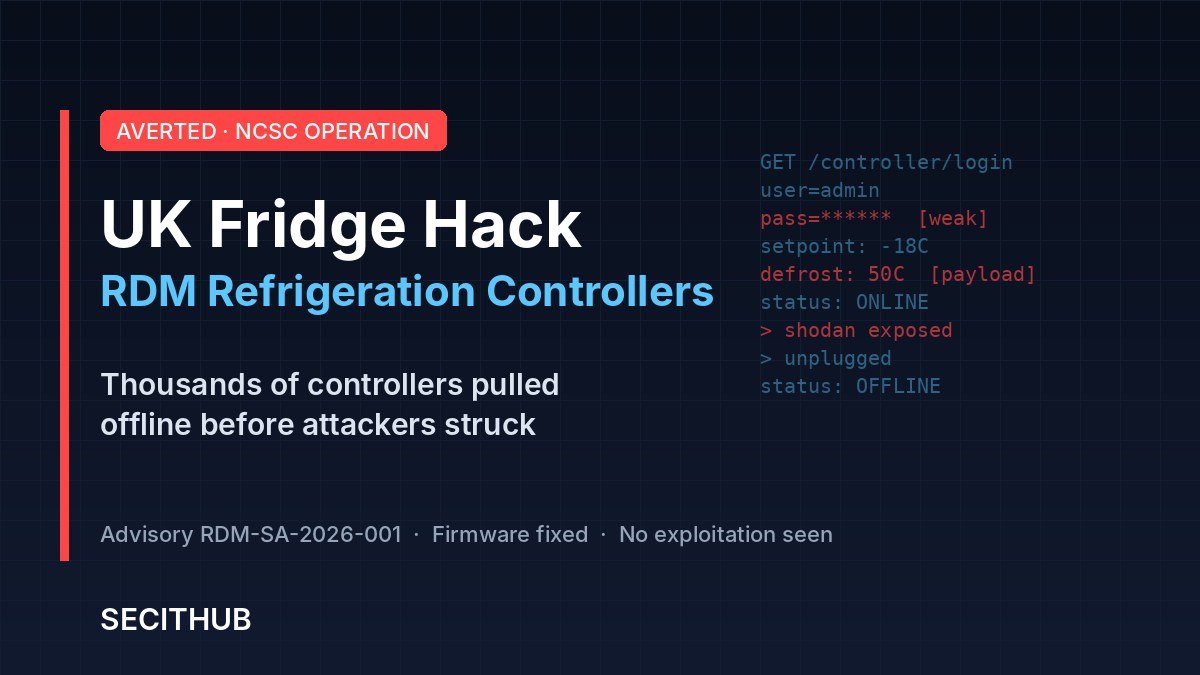
The UK fridge hack that never happened is the most useful security story of the month. In late October, researchers found a flaw in the controllers that run most British supermarket fridges and freezers. Instead of a public race against attackers, the UK ran a quiet, nationwide operation and pulled thousands of controllers off the internet first.
The timing matters. This year attackers hit refrigeration controllers at US military commissaries, hundreds of French supermarkets and stores in seven European countries. We covered the first European wave in Vintage Infrastructure | Why Hacked Supermarket Fridges Are a Warning. This follow-up explains what the UK found, how it responded and what to fix now.
What Happened: The UK Fridge Hack That Was Stopped in Time
A Consultant Spotted the Flaw
Neil McCourt of Omega Solutions, a refrigeration telemetry consultancy, found the weakness. Pen Test Partners then validated it. Its hardware team, led by Andrew Tierney, found several more vulnerabilities and reported them to the manufacturer.
One Controller Runs Dozens of Fridges
The devices come from Resource Data Management (RDM), a Glasgow company that makes the most popular refrigeration controllers in the UK. One RDM controller can manage dozens of fridges and freezers. A single compromised unit can therefore spoil the stock of a whole store.
A Quiet, Nationwide Response
The NCSC, Defra, the Food Standards Agency and the British Retail Consortium joined RDM and the researchers. They held industry calls and contacted companies at risk. According to the BBC:
- Teams took thousands of controllers off the open internet, remotely or by hand.
- Some sites unplugged internet cables and checked temperatures manually.
- One large chain removed hundreds of devices a day for a week.
- Warnings reached petrol stations, restaurants, stadiums, hotels and cold storage sites.
The best incident is the one that never makes the news until it is already fixed.
What We Know About the RDM Controller Vulnerability
The Details Stay Private
Pen Test Partners chose not to publish exploits or its discovery method. It calls the flaw related to, but not identical to, the Danfoss weakness that attackers abused in France. Ken Munro of Pen Test Partners told the BBC the controllers had “a similar weak password problem.”
RDM Disputes the Severity
RDM CEO Ged Evans told the BBC that researchers found the issue in a test environment and dismantled RDM hardware to do it. RDM says an attacker would first need a physical device. The researchers reply that anyone can buy this hardware cheaply online.
A Fix Is Available
RDM published advisory RDM-SA-2026-001 on 2 November 2026 and revised it a day later. It then shipped new firmware that, according to Pen Test Partners, addresses this flaw and several others. RDM says it has seen no malicious activity on its controllers.
- RDM issued advisory RDM-SA-2026-001
- New firmware is available
- The NCSC, Defra and the FSA coordinated the warnings
- RDM reports no malicious activity
- Technical details of the flaw (withheld)
- No CVE has been published
- How many smaller operators remain exposed
- Who ran the November wave in Europe
This is not the first warning about RDM. In 2019, Safety Detective found thousands of RDM systems online, many with default passwords. Remote monitoring keeps putting cooling gear on the public internet.
Why the UK Fridge Hack Matters: Three Waves in 2026
August: US Military Commissaries
Freezers failed at at least six commissaries on US bases. According to Reuters, the Pentagon treats the failures as a suspected hack. Nobody has confirmed the cause.
October: Hundreds of French Supermarkets
Attackers changed defrost settings on Danfoss controllers at about 700 sites. The attack spoiled food and started at least 15 fires. France’s cyber agency ANSSI blames Shahid Kaveh, a unit linked to Iran’s Revolutionary Guard. Iran denies it.
November: Seven European Countries
Fridges failed at stores in Belgium, Luxembourg, Sweden, Finland, Ireland, Estonia and the Netherlands, including about 40 Delhaize shops. No government has attributed this wave.
The Lesson
None of these attacks needed advanced tools. Exposed interfaces, weak passwords and old firmware were enough. Once attackers prove a device class is worth hitting, every similar device becomes a target. That is why the UK treated an unexploited flaw as an emergency.
Hiding the details buys time, not protection.
What to Do Now if You Run Connected Refrigeration or OT
The NCSC advisory on disruptive activity against internet-exposed OT sets the baseline. For cooling, HVAC and building systems, start here:
- Find every controller. List refrigeration, HVAC and building controllers, including units your contractors installed.
- Remove public access. Put management interfaces behind a VPN or private network. Check cellular modems and use a private APN.
- Update firmware. RDM customers should apply the latest firmware. Danfoss and Copeland users should check current advisories.
- Replace default passwords. Use unique credentials per site and user, plus MFA where the device supports it.
- Monitor independently. A separate temperature sensor catches a tampered controller faster than staff will.
- Ask your provider. Find out who controls remote access and how you will hear about the next advisory.
- Use Early Warning. UK organisations can register for the free NCSC service to learn about exposed systems.
The real lesson is simple. Operational technology now sits on the same internet as everything else, and attackers have noticed. The UK got ahead of this one because researchers, a vendor and the government moved fast and kept quiet.
Pen Test Partners admits the job is not finished. Smaller cold chain operators may still be exposed. The question for every business is no longer whether these devices are worth attacking. It is whether you know which of yours the internet can reach.
Find your exposed controllers before someone else does.

It was a weakness in RDM refrigeration controllers, the most widely used fridge controllers in UK supermarkets. Researchers found it in late October 2026, and the UK took thousands of controllers offline before anyone exploited it.
Neil McCourt of Omega Solutions found it. Pen Test Partners validated the finding and discovered several more vulnerabilities in the same devices.
No attack has been reported. RDM says it found no sign of malicious activity on its controllers, and the operation aimed to close the gap before attackers found it.
Yes. RDM issued advisory RDM-SA-2026-001 on 2 November 2026 and released new firmware. Customers should apply it and keep controllers off the public internet.
France attributes the October 2026 attacks on about 700 French sites to Shahid Kaveh, a cyber unit linked to Iran’s Revolutionary Guard. Iran denies it, and nobody has officially attributed the November wave.
Inventory every controller, remove management interfaces from the public internet, update firmware, replace default passwords and monitor temperatures with an independent sensor.
Sources
Pen Test Partners: The fridge hack UK supermarkets narrowly avoided
NCSC: Disruptive cyber activity highlights risk from internet-exposed systems
BBC: Tens of thousands of UK fridges secured from hackers