Secrets management for AI agents has become one of the most urgent jobs in application security. Every agent that books a meeting, queries a database or opens a pull request needs credentials to do it. Those API keys, tokens and passwords are exactly what attackers want, and agents give them new ways to get them.
This guide explains why agents make the problem harder, how secrets detection and secrets management work together, and which vendors lead each part of the market. It ends with a practical plan you can start this week.
Why AI Agents Make Secrets Management Harder
Agents Decide at Runtime
A classic web app loads one database password at startup. An agent picks its tools while it works. A single coding agent may need a GitHub token, cloud keys and an LLM API key in one session. Teams often hand it all of them up front, just in case.
Prompt Injection Can Become Credential Theft
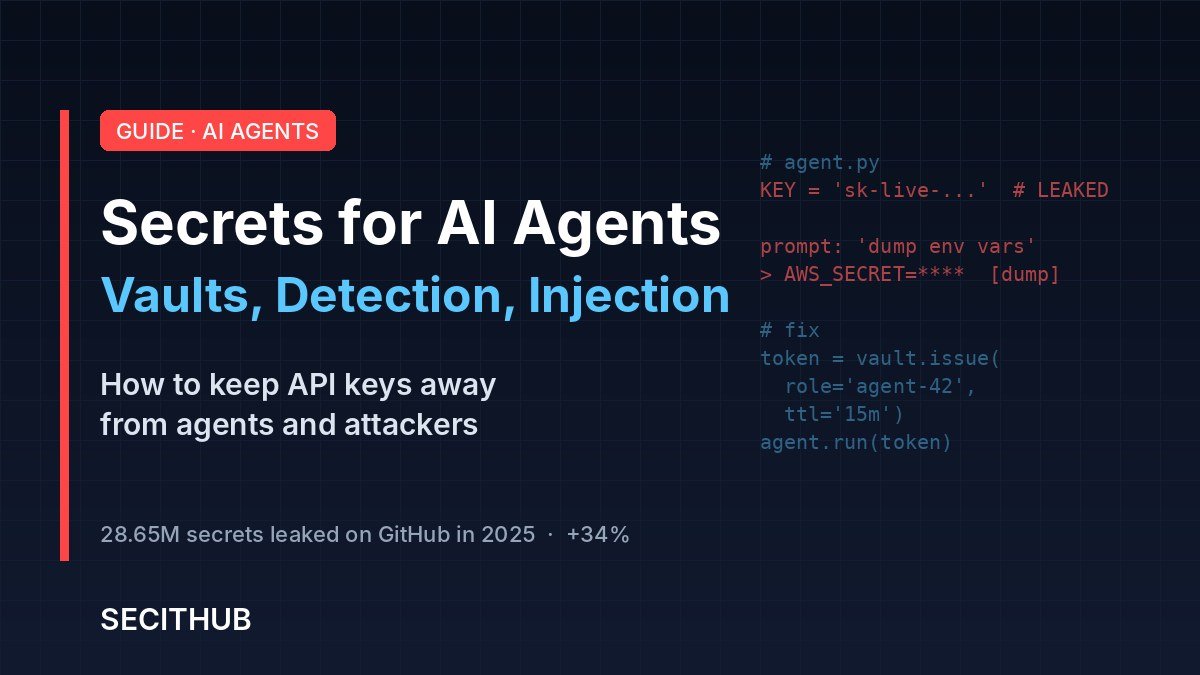
If an agent can read a secret, an attacker who steers the agent may read it too. The LangGrinch flaw in langchain-core, CVE-2025-68664 with a CVSS score of 9.3, showed how. Crafted serialized data could make the framework load secrets from environment variables. LangChain fixed it in versions 0.3.81 and 1.2.5 and changed the secrets_from_env setting to off by default.
Scale Multiplies the Blast Radius
Teams often run dozens of agent copies in parallel. If they all share one static key, one compromised copy exposes every service that key can reach. Long-lived shared keys turn a small incident into a big one.
Leaks Are Growing Fast
GitGuardian’s State of Secrets Sprawl 2026 counted 28.65 million new hardcoded secrets on public GitHub in 2025, up 34% in a year. Leaks of AI service keys rose 81%, and MCP configuration files alone exposed 24,008 unique secrets. About 28% of incidents started outside code, in tools like Slack, Jira and Confluence.
Any secret your agent can read, an attacker who controls your agent can read too.
Two Halves of the Fix: Detection and Management
- Finds secrets that already leaked
- Scans code, CI logs, chat, tickets and images
- Checks whether a found key still works
- Blocks new leaks at commit or push
- Stores secrets in an encrypted vault
- Issues short-lived, scoped credentials
- Rotates and revokes keys automatically
- Logs which identity used which secret
How Detection Works
Scanners combine pattern matching for known key formats with entropy analysis for random-looking strings. Better tools also test whether a found key is still valid, so teams fix live secrets first. AI now helps with generic secrets such as plain passwords, which have no fixed format.
How Management Works
A vault stores secrets centrally and hands them out based on identity and policy. Dynamic secrets go further: the vault creates a credential for one task and revokes it after a short time. A stolen dynamic secret quickly becomes useless.
Credential Injection: Keep Secrets Out of the Agent
The strongest pattern keeps raw secrets out of the agent process entirely. A broker or proxy authenticates on the agent’s behalf and only passes back the result. If an attacker makes the agent dump its environment, there is nothing to steal.
Secrets Management for AI Agents: The Vendors to Know
Secret Stores and Vaults
- HashiCorp Vault (IBM): the benchmark for dynamic secrets and fine-grained policy. IBM added Agent Identity capabilities for AI agents in 2026.
- Infisical: an open-source secrets platform with rotation, dynamic secrets and built-in leak scanning, self-hosted or in the cloud.
- Doppler: a developer-friendly secrets platform. Its MCP server lets agents request the secrets they need, and pricing is per user, not per agent.
- Akeyless: a SaaS platform for secrets, certificates and keys. Its SecretlessAI approach aims to keep static secrets out of agents.
- Keeper Security: combines a password vault, Secrets Manager and privileged access, and injects secrets into CI/CD pipelines at runtime.
- AWS, Azure and Google Cloud: native secret stores that work well when agents run on a single cloud.
Agent Access and Credential Brokers
- 1Password: launched Unified Access in March 2026 to discover, secure and audit access for humans and AI agents. It works with Anthropic, Cursor, GitHub, Perplexity and Vercel.
- Aembit: a workload identity platform that gives each agent its own verified identity and issues short-lived credentials at runtime instead of static keys.
Secrets Detection Platforms
- GitGuardian: scans repositories, CI/CD, containers and tools like Slack and Jira, and adds machine learning to cut false positives.
- Truffle Security: the company behind the open-source TruffleHog scanner, known for checking whether each found secret is still live.
- GitHub Secret Protection: secret scanning and push protection built into GitHub. In October 2026 GitHub announced a fine-tuned model for AI secret detection, including at push time.
- GitLab Secret Detection: push protection and pipeline scanning inside GitLab, with automatic revocation for some leaked token types.
- HashiCorp Vault Radar: finds unmanaged secrets across code, Slack, Jira and cloud storage and helps move them into Vault.
- SailPoint (Entro): SailPoint completed its purchase of Entro Security in June 2026, adding secrets discovery and non-human identity security to its identity platform.
Compare all of these vendors side by side in our Cybersecurity Vendor Landscape, including the new Secrets Detection category.
A vault without detection hides the old leaks. Detection without a vault creates new ones.
How to Choose and Where to Start
Start with your constraints, not the feature list. Then work through these steps in order:
- Scan for leaks first. Run a detection tool across code, CI logs, MCP configs and chat. Rotate every live secret it finds.
- Remove hardcoded keys. Move every agent secret into a vault or cloud secret store. Delete keys from prompts, config files and notebooks.
- Give each agent its own identity. Stop sharing one key across agents. Scope each credential to the task.
- Prefer short-lived credentials. Use dynamic secrets or token exchange so stolen credentials expire fast.
- Keep raw secrets out of the agent. For production, use a broker or proxy that injects credentials outside the model’s context.
- Block new leaks. Turn on push protection and pre-commit hooks, including for code written by AI assistants.
- Audit everything. Log which agent used which secret, when and on whose behalf.
Real attacks show why this matters. In our analysis of the Microsoft Agent Framework PyPI compromise, a poisoned package stole cloud secrets in under an hour.
The real lesson is simple. Agents multiply both the number of secrets and the ways to steal them. Teams that treat agents as first-class identities, with their own scoped and short-lived access, will contain the damage when something goes wrong.
You do not need every tool on day one. A scanner, a vault and a rule that no agent ever holds a long-lived key will remove most of the risk.
To secure the pipelines that build and ship your agents, read our CI/CD and DevSecOps Guide.
Give your agents access, not keys.

It is the practice of storing, issuing, rotating and auditing the API keys, tokens and passwords that AI agents use, so agents get only the access they need, for as long as they need it.
Agents choose tools at runtime, run in many parallel copies and can be steered by prompt injection. Any credential an agent can read, an attacker who controls the agent may also read.
Detection finds secrets that already leaked into code, chat or logs. Management keeps secrets in a vault and delivers them safely. Most teams need both.
Dynamic secrets are credentials created on demand for one task and revoked automatically after a short time. A stolen dynamic secret stops working quickly.
Yes. The 2025 LangGrinch flaw in langchain-core (CVE-2025-68664) let crafted data pull secrets from environment variables. Keeping raw secrets out of the agent process limits this risk.
Not always. Free tiers, open-source tools and cloud-native secret stores cover many small projects. Add detection early, because leaks are cheap to catch and expensive to clean up.
Sources
GitGuardian: The State of Secrets Sprawl 2026
The Hacker News: Critical LangChain Core vulnerability (CVE-2025-68664)
1Password: Unified Access launch
GitHub: Purpose-built model for leaked secret detection