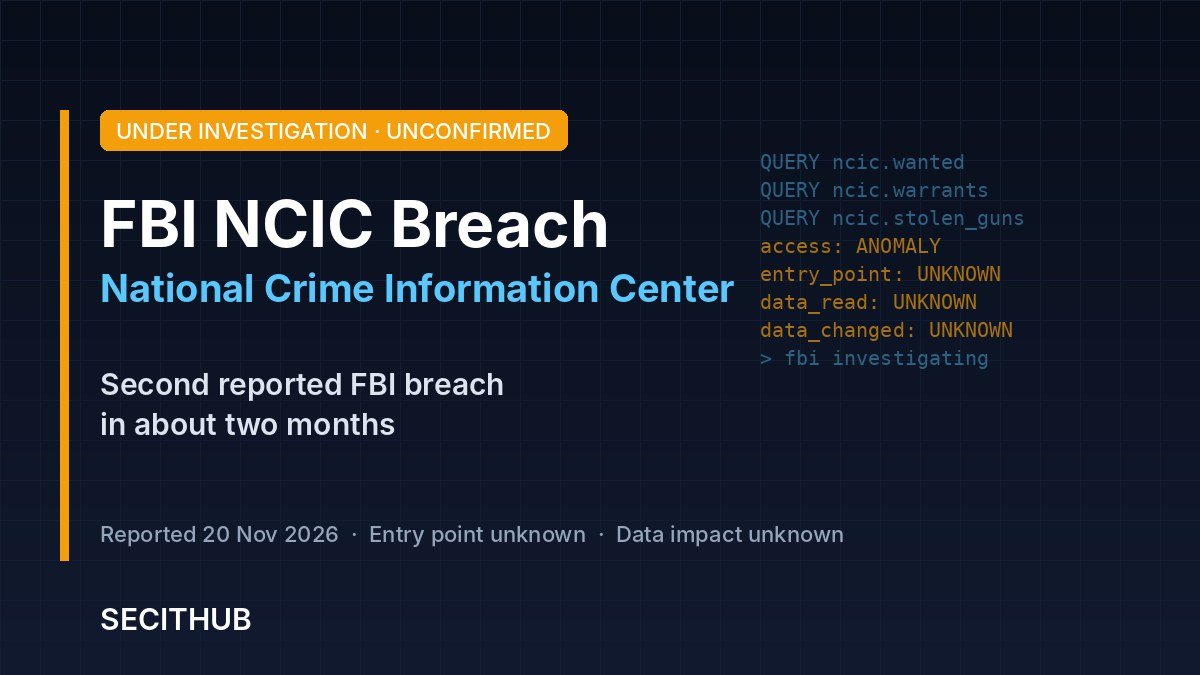
The FBI NCIC breach puts one of the most sensitive systems in American policing under the spotlight. The FBI is investigating an apparent intrusion into the National Crime Information Center, known as NCIC. CNN first reported the breach on 20 November 2026, citing two people briefed on the investigation. The FBI has not publicly confirmed the incident.
NCIC is not a typical government website. Police officers use it every day during traffic stops, arrests and background checks. It is also the second reported breach of FBI systems in about two months. That makes this story bigger than one incident. It raises hard questions about how federal agencies protect shared law enforcement data.
What Happened in the FBI NCIC Breach
The First Reports
CNN reported that the FBI is investigating an apparent breach of NCIC. According to CNN, two people briefed on the issue confirmed the investigation. Fox News later reported the breach, citing three sources familiar with the matter.
What the FBI Has Said
So far, the FBI has said very little in public. It did not respond to requests for comment from CNN or BleepingComputer. President Donald Trump discussed the breach in a Fox News interview on Saturday but did not share details about the intrusion.
The Open Questions
Fox News reported that investigators are still looking for the unauthorized entry point. It is also unclear what information, if any, was accessed. BleepingComputer noted that it is not known when the breach happened or whether it disrupted police access to the system.
An unconfirmed breach is not a harmless breach. It is an unanswered one.
Why NCIC Is Such a Sensitive Target
- CNN first reported the apparent NCIC breach, citing two people briefed on it
- Fox News reported the breach citing three sources
- The FBI is investigating the intrusion
- It is the second reported FBI breach in about two months
- When the intrusion happened
- How the attackers got in
- Whether any data was stolen or changed
- Who is behind it, or any link to ShinyHunters
A Database Every Officer Relies On
The FBI runs NCIC as a shared system for federal, state and local agencies. It holds records on wanted and missing persons, arrest warrants, stolen vehicles and firearms, and protection orders. It also supports background checks. NCIC has served as an information sharing tool since 1967.
Integrity Matters as Much as Secrecy
Most breach stories focus on stolen data. With NCIC, the bigger fear may be changed data. A former FBI official who led cybercrime investigations told CNN that the key concern is whether hackers could compromise the accuracy of the records. Officers make fast decisions based on these records. A fake warrant or a deleted alert could put officers and the public at risk.
A Wide Attack Surface
NCIC is reached through thousands of agencies, terminals and state systems. Every connected account is a possible door. That is why access control, monitoring and audit trails matter so much for shared databases like this one.
A Pattern: The Second FBI Breach in Two Months
The ShinyHunters Attack on FBIJobs.gov
In September 2026, the ShinyHunters extortion group claimed it had breached the FBI. The attack hit a third-party platform linked to FBIJobs.gov, the bureau’s recruiting site. According to BleepingComputer, the attackers exploited an unpatched Oracle PeopleSoft vulnerability. FBI Director Kash Patel later said the breach occurred on a platform managed by a third-party vendor.
Arrests Followed
The FBI and Dutch police said a suspected ShinyHunters member was arrested in Amsterdam on 15 September. In October, Patel announced the arrest of another suspected co-conspirator, a Canadian cybersecurity executive. The charges and his exact role are still working through the courts.
No Known Link Yet
There is no public evidence that the NCIC incident is tied to ShinyHunters. BleepingComputer said there is currently no indication of a connection. Until the FBI shares more, readers should treat the two incidents as separate.
A Tense Backdrop
The reports come after a string of high-profile US outages that we covered in our AI cyber defense and outages report. Earlier this year, the FBI also ran Operation Winter SHIELD, a campaign that pushed organizations to adopt ten basic defensive actions.
The defender's checklist applies to the defender too.
What Happens Next
The FBI will need to answer three questions. First, how did the attackers get in? Second, did they read, copy or change any records? Third, is the intrusion fully contained? The answers will shape what agencies across the country must do next. If records were altered, agencies may need to validate entries they depend on every day. If credentials were abused, password resets and access reviews could follow. Watch for an official FBI statement, as well as any notices sent to state agencies that manage NCIC access.
Lessons for Security Teams
Most organizations do not run a national crime database. Still, the lessons here apply to any shared system with many users and third-party links. Start with these steps:
- Patch third-party platforms fast. The FBIJobs.gov breach reportedly started with a missing vendor patch. Track vendor systems in your patch program.
- Use phishing-resistant MFA. It is the first action on the FBI’s own Winter SHIELD list. Apply it to every account that touches sensitive data.
- Watch for data changes, not just data theft. Log every write, edit and delete on critical records, and alert on unusual changes.
- Review shared access. Remove stale accounts and limit each user to the records they need.
- Know your vendors. Map which outside platforms connect to your core systems. Our Cybersecurity Vendor Landscape covers third-party risk tools.
- Test your response plan. Run an exercise that assumes a trusted database was altered, not only leaked.
For Law Enforcement Agencies
Agencies that connect to NCIC should not wait for an FBI statement. Review recent query and update activity for unusual patterns. Confirm that every terminal and user account is still needed. Make sure officers know how to verify a hit through a second channel before acting on it.
The FBI NCIC breach is still a developing story. The key facts will come from the FBI’s own findings. Until then, the safest move is to assume shared data can be wrong and build checks around it. For more on limiting who can reach sensitive systems, read our Zero Trust Access Guide.
Trust the record, but verify the system behind it.

The FBI is investigating an apparent intrusion into the National Crime Information Center, a nationwide law enforcement database. CNN first reported it on 20 November 2026. The FBI has not publicly confirmed the incident.
Police agencies across the US use NCIC to check for warrants, wanted and missing persons, stolen vehicles and firearms, and protection orders. It also supports background checks.
That is not known yet. Reports say investigators have not determined what information, if any, was accessed, stolen or changed.
There is no public evidence of a link. ShinyHunters claimed a separate breach of the FBIJobs.gov portal in September 2026, and BleepingComputer reported no indication of a connection.
Officers make fast decisions based on NCIC records. If attackers could change records, a false warrant or a missing alert could put officers and the public at risk.
Patch third-party platforms quickly, use phishing-resistant MFA, log changes to critical records, review shared access and test incident response plans.
Sources
BleepingComputer: FBI reportedly hacked again, this time targeting nationwide police database
Fox News: FBI probes second cyberattack in months as hackers breach key crime database
The Record: FBI touts another ShinyHunters arrest in response to data breach
FBI: Operation Winter SHIELD