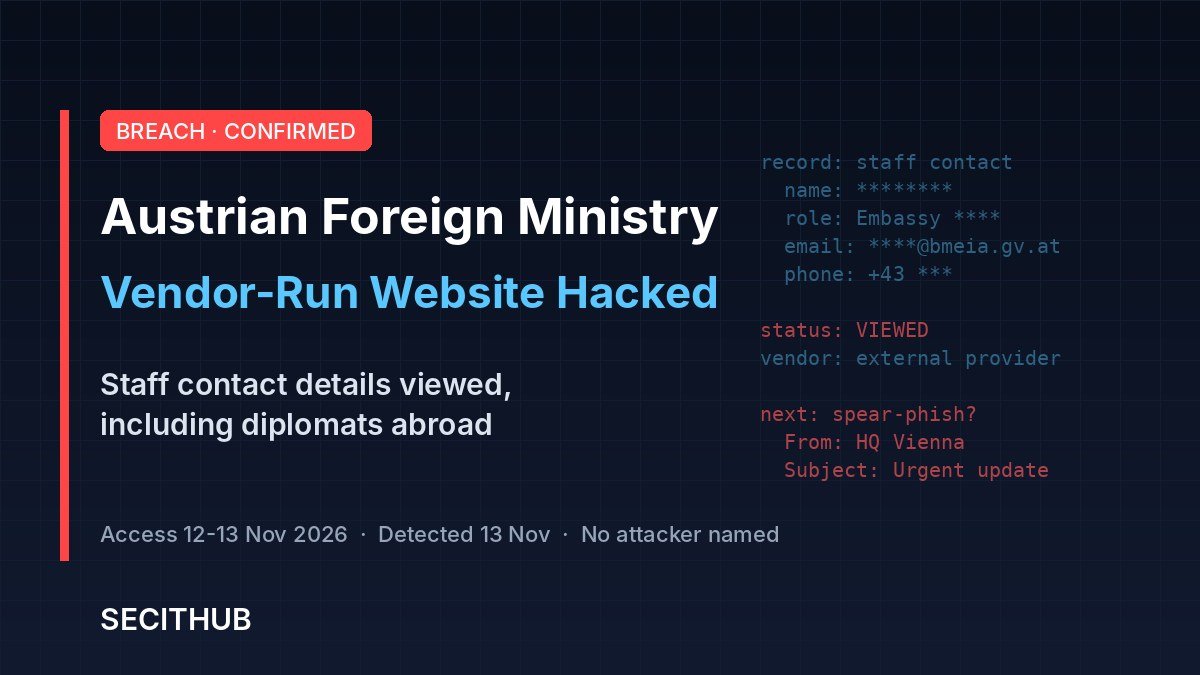
The Austrian Foreign Ministry hack shows how a simple website can open a door to diplomats. Austria’s foreign ministry said on 20 November that attackers broke into its public website the week before. The site is run by an external service provider. Investigators found that the intruders viewed records with the names and work contact details of ministry staff, including people at diplomatic missions abroad.
On paper, names and work emails sound like low-value data. In practice, they are the raw material for targeted phishing. For a foreign ministry with a long record of state-backed attacks, that matters a lot.
What Happened in the Austrian Foreign Ministry Hack
A Vendor-Run Website Was the Target
According to the ministry’s statement, quoted by Reuters, the website was accessed without authorization between 12 and 13 November. An external service provider operates the site. The ministry detected the intrusion on 13 November and says it stopped it immediately.
Staff Records Were Viewed
A team of experts then investigated the incident. They found that the intruders viewed records listing names and work contact details. The records covered staff at the Vienna headquarters and at Austrian missions abroad. The ministry said the incident did not affect citizens’ personal data.
Authorities Were Notified
Austrian media report that the ministry notified the Federal Office for Cyber Security and the Data Protection Authority, as the law requires. Together with the provider, it took steps to block further access. It also launched extra technical security checks.
A staff directory is not a secret. A verified staff directory in an attacker's hands is a target list.
What We Know and What Is Still Unclear
- The breach hit a website run by an outside provider
- Access took place on 12 and 13 November 2026
- Names and work contact details of staff were viewed
- The ministry says citizen data was not affected
- How many records were viewed
- Whether the data was copied
- Which flaw or technique was used
- Who is behind the attack
The Microsoft Outage Question
The ministry said the access happened during a global Microsoft outage. That timing has drawn attention, but the ministry has not linked the two events. Security Affairs notes there is no evidence that the attackers exploited the outage. Still, outages create noise. Alerts get missed and teams focus on restoring service. For background, read our analysis of the 12 November Microsoft 365 outage.
No Attacker Named
The ministry did not say whom it suspects. No country or threat group has been named, and there is no public evidence of a state-backed operation this time. Readers should treat any attribution claims with caution until officials say more.
A Ministry With a Long Target History
The 2020 Espionage Attack
At the start of 2020, the ministry suffered a serious cyberattack that lasted for weeks. In July 2026, Austria publicly blamed that attack on Turla. According to Austrian media, the ministry says Russia’s FSB intelligence service controls the group, and internal data linked to Russia was stolen. Russia has denied Western hacking accusations.
Phishing Waves and Diplomatic Tension
In April 2022, the ministry faced attacks using phishing emails. Tension with Moscow has also grown. Security Affairs reports that Austria expelled four Russian diplomats in October 2026. None of this proves who is behind the new breach. It does show why the ministry’s staff are an attractive target.
Attackers rarely need the crown jewels on day one. They need a name, a title and an inbox.
Why Contact Details Are a Phishing Goldmine
Names, roles and work contact details let attackers build convincing spear phishing. They know who works where, who reports to whom and which mission to impersonate. A fake email from “headquarters” to an embassy feels routine. That is exactly why it works.
Diplomats are also high-value targets for espionage. One successful click can lead to mailbox access, internal documents and contact lists of foreign officials. Attackers also use this data for vishing, fake meeting invites and lookalike domains. Our report on help desk and phishing attacks shows how far a few personal details can take an attacker.
The Third-Party Angle
The breach also fits a wider pattern. Attackers often skip hardened core systems and go after a supplier instead. The FBIJobs.gov breach we covered in our FBI NCIC report followed the same path. So did the Optimizely supply chain attack. A website run by a vendor is still your website in the eyes of the public and of attackers.
Lessons for Security Teams
Most organizations do not run embassies. Still, many hold staff directories on websites, intranets or portals run by vendors. Start with these steps:
- Warn exposed staff right away. Tell them to expect targeted phishing and fake calls that use their real details.
- Tighten email defenses. Enforce DMARC, flag external senders and watch for lookalike domains of your own brand.
- Use phishing-resistant MFA. Stolen passwords matter less when logins need a hardware key or passkey.
- Inventory vendor-run sites. List every website and portal a supplier operates for you, and what data each one holds.
- Limit what public systems store. A public website should not hold a full staff directory if it does not need one.
- Set vendor security terms. Require patching timelines, logging and fast breach notice in every contract.
- Raise monitoring during outages. Treat a major outage as a higher-risk window, not a quiet one.
The Austrian Foreign Ministry hack is a reminder that small data can carry big risk. The ministry moved fast to stop the intrusion and notify regulators. The next test is whether its staff can spot the phishing that may follow. To compare third-party risk and email security tools, see our Cybersecurity Vendor Landscape.
Protect the people in the directory, not just the server that holds it.
Attackers accessed the ministry’s website, which an external service provider runs, between 12 and 13 November 2026. They viewed records with names and work contact details of staff in Vienna and at missions abroad.
The ministry said the incident did not affect citizens’ personal data. The records that were viewed related to ministry staff.
No attacker has been named. The ministry did not say whom it suspects, and there is no public evidence of a state-backed operation in this incident.
The access happened during a global Microsoft outage, but the ministry has not established a link between the two events.
Names, roles and work contact details help attackers craft convincing spear phishing, fake calls and lookalike emails aimed at specific employees.
Yes. A serious attack hit the ministry in early 2020, which Austria later blamed on the Turla group. It also faced phishing attacks in April 2022.
Sources
Reuters via U.S. News: Austrian foreign ministry says its website was hacked, staff details viewed
Security Affairs: Cyberattack on Austrian Foreign Ministry exposes diplomatic staff data
APA via Kronehit: Cyberangriff auf Außenministerium (German)
Salzburg24: Russian hacker group named behind the 2020 ministry attack (German)