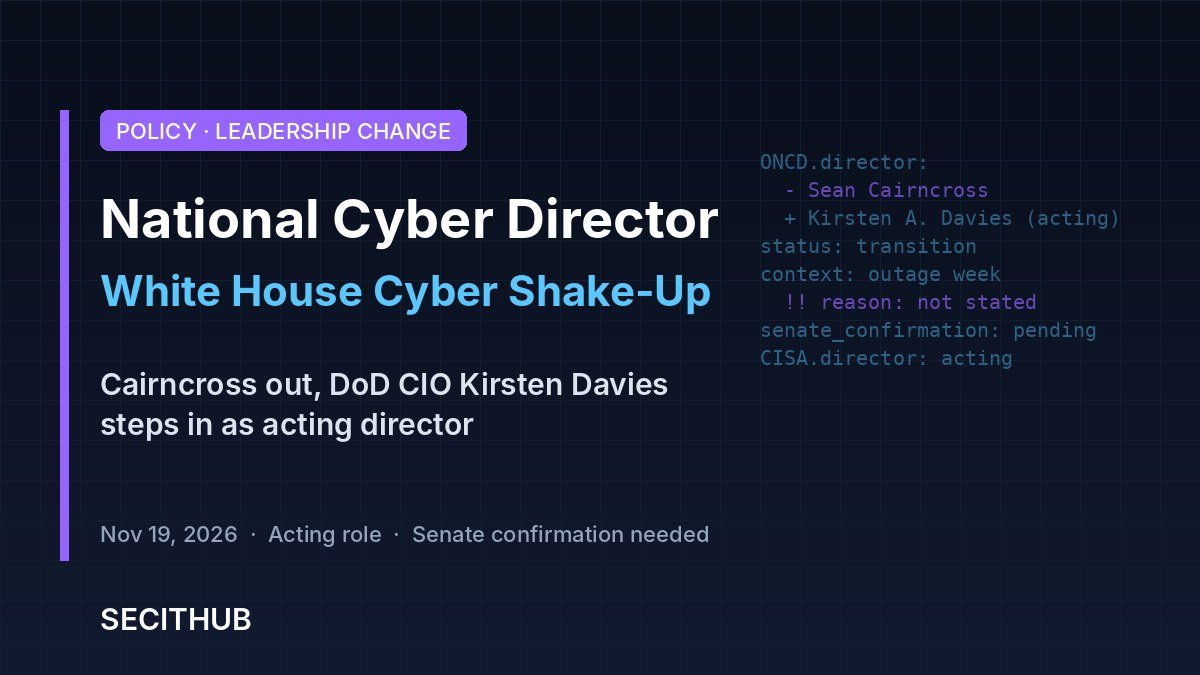
The White House has replaced its national cyber director in the middle of one of the most turbulent weeks US technology has seen in years. Sean Cairncross, who has led the Office of the National Cyber Director since August 2025, is leaving. Kirsten A. Davies, the Defense Department’s chief information officer, will take over on an acting basis.
The change comes after a string of outages hit airlines, banks, Microsoft services and federal agencies. Officials have said those outages were not a cyberattack. Still, the timing raises a fair question for anyone who works in security: what does a leadership change at the top of US cyber policy mean right now?
What Happened at the Office of the National Cyber Director
Axios first reported the move on November 19, and several outlets confirmed it with White House officials and sources close to the administration. The White House did not say when Cairncross’s last day would be.
Who is leaving
Cairncross is a longtime Republican lawyer. During his time in office, he played a central role in the administration’s AI policy discussions, in addition to his cyber portfolio. The Washington Post reported that his exit is part of a wider departure of aides linked to former White House chief of staff Susie Wiles.
Who is stepping in
Kirsten A. Davies currently serves as the Defense Department’s chief information officer. She will lead the office in an acting role. A permanent national cyber director needs Senate confirmation, so the post could stay in acting hands for some time.
What we do not know
The White House has not publicly given a reason for the change. Reports describe the timing alongside the outages, but no official statement directly links the two. Readers should treat any claim of a direct link as speculation until the administration says more.
A new leader at the top of US cyber policy, an acting title, and a week of outages.
The timing is clear. The reason is not.
What the National Cyber Director Actually Does
Many people confuse this role with CISA. They are different jobs.
Policy and coordination, not operations
The Office of the National Cyber Director sits in the White House. Congress created it, and it started operating in 2021. It advises the President on cybersecurity and coordinates cyber policy and strategy across federal agencies. It also works on protecting federal networks and critical infrastructure.
CISA, by contrast, is the operational agency inside the Department of Homeland Security. It issues alerts, runs the Known Exploited Vulnerabilities catalog and works directly with critical infrastructure operators.
| Area | National Cyber Director (ONCD) | CISA |
|---|---|---|
| Location | White House | Department of Homeland Security |
| Main role | Strategy, policy and coordination | Operations, alerts and response support |
| Works with | The President and all federal agencies | Agencies, industry and infrastructure operators |
| Leadership | Senate-confirmed director | Senate-confirmed director |
Why “acting” matters
An acting director can run the office day to day. But an acting title often carries less weight in long-term planning and in negotiations with Congress and industry. CISA has also been led by acting leadership for much of 2026. That leaves both top US civilian cyber posts without confirmed leaders at a sensitive moment.
Why the Timing Matters for Security Teams
The change lands in a week full of pressure on US cyber policy.
The outage week
An FAA ground stop, Microsoft 365 problems, bank outages and an NSA network disruption all hit within days. Senior officials told Congress the incidents were separate and tied to maintenance and technical changes, not a coordinated attack.
Read the full background: US Tech Outages | Why a Week of Failures Was Not a Cyber Attack
Pressure from Congress
Days earlier, Senators Maria Cantwell and Mike Rounds asked the White House for a national strategy against AI-enabled cyber threats. Their core concern: AI now finds software flaws faster than organizations can safely patch them, and rushed patching can itself cause outages.
Continuity is the real risk
Leadership changes do not cause or fix outages on their own. The bigger question is continuity. Strategies, partnerships with industry and AI security plans all slow down when the people driving them change. For defenders, that means federal guidance may take longer to arrive.
What Security Leaders Should Do Now
You cannot control who runs US cyber policy. You can control how your own organization handles the same risks.
- Do not wait for Washington. Build your own plan for faster patching and safer rollouts.
- Treat change management as a security control. Stage updates, test rollbacks and avoid patching every critical system at once.
- Map your dependencies. Know which cloud, identity and SaaS providers your business cannot run without, and what you do when one goes down.
- Keep following primary sources. CISA alerts and the KEV catalog still drive patch priorities, whoever leads policy.
- Brief your board. Explain the difference between an outage and an attack, and how you would tell them apart.
SECITHUB Take
Personnel changes make headlines, but they rarely change what happens inside a SOC on Monday morning. The real lesson of this week is structural. Software flaws are being found faster, patches are landing in larger waves, and systems built for a slower pace are struggling. Whoever leads US cyber policy next will inherit that problem. Organizations that invest now in safe change management, resilience and clear ownership will be in better shape than those waiting for the next federal strategy.
Leaders change.
The patch queue does not wait.
Does leadership change in Washington affect your security planning?
Share your view at r/secithubcommunity

Kirsten A. Davies, the Defense Department’s chief information officer, is taking over the Office of the National Cyber Director on an acting basis, according to reports confirmed by White House officials and sources.
The White House has not publicly stated a reason. The change was reported during a week of major US tech outages, but no official statement directly links the two.
The national cyber director leads the White House Office of the National Cyber Director, which advises the President on cybersecurity and coordinates cyber policy and strategy across federal agencies.
The national cyber director focuses on policy, strategy and coordination from the White House. CISA is the operational agency in the Department of Homeland Security that issues alerts, runs the KEV catalog and works directly with critical infrastructure.
Senior officials told Congress the outages were separate incidents tied to maintenance and technical changes, not a coordinated or state-sponsored attack.
Keep following CISA alerts and the KEV catalog, strengthen change management and rollback plans, map critical dependencies, and avoid waiting for new federal guidance before improving resilience.
Sources
White House replaces top cybersecurity official after string of outages – The Washington Post
White House national cyber director being replaced as nation reels from tech outages – CNN