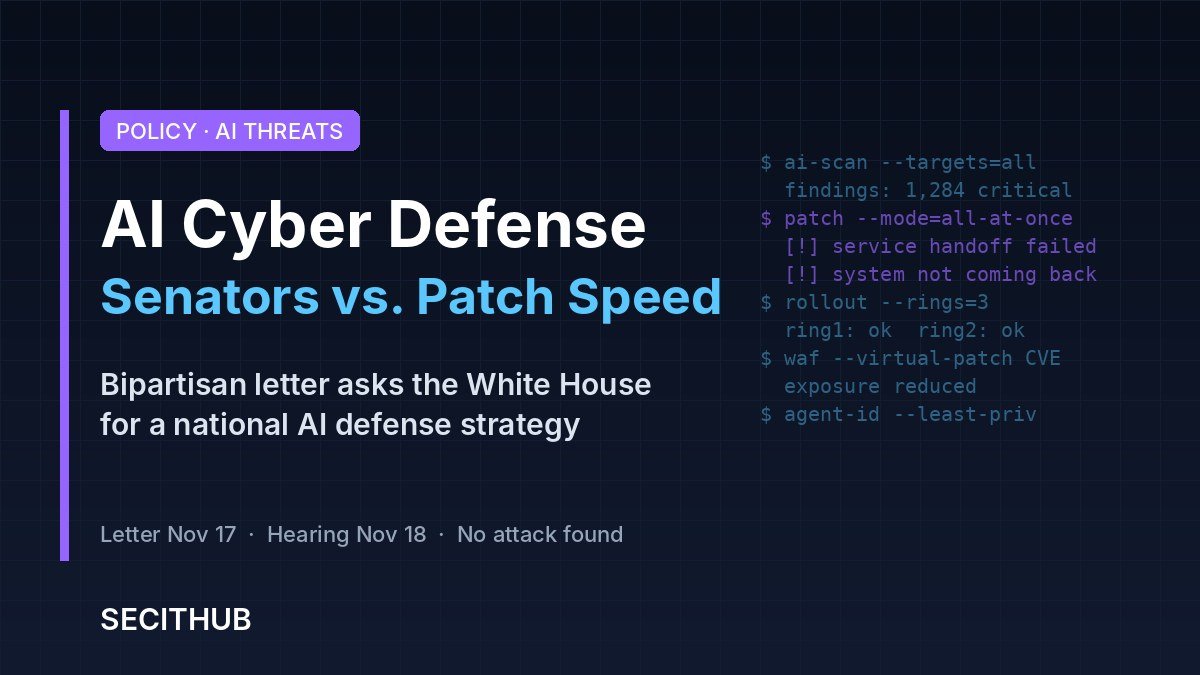
Two US senators want a national AI cyber defense plan, and they want it now. Maria Cantwell and Mike Rounds sent a bipartisan letter to Jay Clayton, the Director of National Intelligence and head of the White House AI task force. It landed on November 17, in the middle of a week of outages at banks, airlines, Microsoft services and even the NSA.
Officials say none of those outages was an attack. The senators are making a different point. AI now finds software flaws faster than most organizations can fix them. Rushed patching itself has become a risk. This article explains what the letter asks for, why the outage week matters, and what security teams should change before the next wave of fixes.
What the Senators Asked the White House to Do
Cantwell is the top Democrat on the Senate Commerce Committee. Rounds, a Republican, chairs the Senate Armed Services subcommittee on cybersecurity. This is their second joint letter on the topic. In October they asked the administration for AI security standards, independent testing and defensive AI tools.
The core argument
AI models can now find and exploit weaknesses at machine speed. Defenders still patch at human speed. Testing and rolling out a fix across connected systems can take weeks or months. During that window, attackers have a working target, and the patch work itself can knock services offline.
The specific requests
- Speed up the build and rollout of AI-powered defensive tools.
- Set security standards for autonomous AI agents.
- Bring AI labs, security vendors, infrastructure operators, NIST and CISA to one table through the AI task force.
- Build tools that keep finding flaws, test fixes and block attacks before they spread.
- Make CISA responsible for getting those tools into banks, hospitals, utilities and government agencies.
- Launch a national cyber defense “grand challenge” to cut the time from discovery to protection.
- Lock down the AI systems used to hunt for flaws, so they cannot be turned against sensitive networks.
The message is simple: finding bugs is no longer the bottleneck. Fixing them safely is.
Why the Outage Week Made AI Cyber Defense Urgent
The letter arrived during a rough stretch for US infrastructure. Flights were halted nationwide by an FAA ground stop. Microsoft 365, several large banks and Apple services had problems within days. A network disruption hit the NSA.
What officials told Congress
On November 18, Clayton, Homeland Security Secretary Markwayne Mullin and FBI Deputy Director Christopher Raia testified before the House Homeland Security Committee. All three said they saw no sign of malicious activity. Clayton called the incidents separate outages tied to maintenance and technical changes. In his words, “They are not a coordinated or state-sponsored attack.”
For the FAA stop, officials pointed to maintenance by contractor L3Harris, which was replacing old copper lines with fiber. Lawmakers pushed back on the NSA incident, and its cause stayed unclear.
The patching explanation
Clayton has linked the outages to a wider patching push. AI scanners are surfacing vulnerabilities faster than ever. Institutions are taking systems down to fix them at a much larger scale. Some systems are not coming back as expected, and handoffs between systems are failing.
Senator Mark Warner, the top Democrat on the Intelligence Committee, made a similar point. AI finds flaws across huge numbers of systems at once. That creates pressure to patch everything at the same time, and older systems were not built for that pace. It is still unclear whether AI played any direct role in the outages.
The Patch Paradox Behind the Letter
Security teams have always asked for faster patching. Now they are getting more fixes than their systems can absorb. That is the patch paradox: the faster flaws are found, the more change hits production, and the more things break.
The incidents the senators cited
The letter points to several recent cases:
- Java4Shell: a CISA alert on an AI-discovered flaw in Java.
- Japan: an AI-powered intrusion linked to an email data breach at the City of Osaka.
- Banks: AI agents now access customer accounts, and some banks cannot tell a rogue agent from a legitimate one.
- FBI warning: a Chinese tool that automates large parts of an intrusion, used in attacks in Japan, South Korea and the US.
Why discovery speed changes everything
AI models have found dozens of flaws in major platforms in recent months. Attackers have also shown they can turn a fresh patch into a working exploit with almost no human effort. The gap between “fix released” and “exploit in the wild” is shrinking from weeks to hours.
Slow patching leaves the door open.
Rushed patching takes the house offline.
Defenders now need speed and safety at the same time.
What Security Teams Should Do Now
A national strategy will take time. Your patch queue will not wait. These steps help you move fast without causing your own outage.
1. Rank fixes by real exposure
Patch internet-facing systems and actively exploited flaws first. Use the CISA KEV catalog and your own asset inventory. A critical bug on an isolated test box can wait. A medium bug on your VPN cannot.
2. Roll out in rings
Deploy to a small group first, watch it, then expand. Keep a tested rollback plan for every major change. Never patch every critical system in one window.
3. Use compensating controls while you wait
When a fix needs weeks of testing, reduce exposure in the meantime. Block the vulnerable path with a WAF rule, restrict access, or turn off the affected feature. This is often called virtual patching.
4. Map your dependencies
Many of last week’s failures came from handoffs between systems. Know which services depend on each other before you take one down. Coordinate maintenance windows with key vendors and partners.
5. Give AI agents an identity
Treat every AI agent like a user account. Give it its own credentials, least privilege and full logging. If a bank cannot tell a rogue agent from a real customer, neither can your SOC.
6. Put AI on the defense side
Use AI to scan your own code and configs before attackers do. Use it to test patches and spot unusual behavior. Then secure those tools as tightly as any admin account.
The senators are right about one thing: this is not only a government problem. Every organization now runs the same race between discovery and repair. The winners will be the teams that can patch quickly and recover cleanly when a fix goes wrong.
How is your team handling the new patch pace?
Join the discussion with security pros at r/secithubcommunity

They asked DNI Jay Clayton, who leads the White House AI task force, to build a national AI cyber defense strategy. Their requests include defensive AI tools, security standards for AI agents, a CISA role in deploying those tools to critical infrastructure, and a national challenge to shorten the time from discovery to protection.
Officials say no. At a House hearing, the DNI, the Homeland Security Secretary and the FBI Deputy Director said they saw no sign of malicious activity. They described the incidents as separate outages tied to maintenance and technical changes.
Officials have linked the outages to a large wave of patching. AI scanners are finding vulnerabilities faster, so organizations are taking more systems offline to fix them. Some systems did not come back cleanly. It is still unclear whether AI played any direct role.
The faster AI finds flaws, the more fixes hit production at once. Slow patching leaves systems exposed, but rushed patching can cause outages. Defenders now need both speed and safe rollout.
Rank fixes by real exposure, roll out in small rings with rollback plans, use virtual patching while fixes are tested, and map dependencies between systems before maintenance.
AI agents can log in, move data and take actions on their own. Without separate identities, least privilege and logging, a rogue or hijacked agent looks like a real user. The senators asked for standards to close that gap.
Sources
Cantwell and Rounds letter on AI and cybersecurity, November 2026 – U.S. Senate Commerce Committee
Lawmakers call on White House to develop defensive AI cyber systems – The Record
“No indication” recent outages are related to coordinated cyberattacks, officials say – CBS News