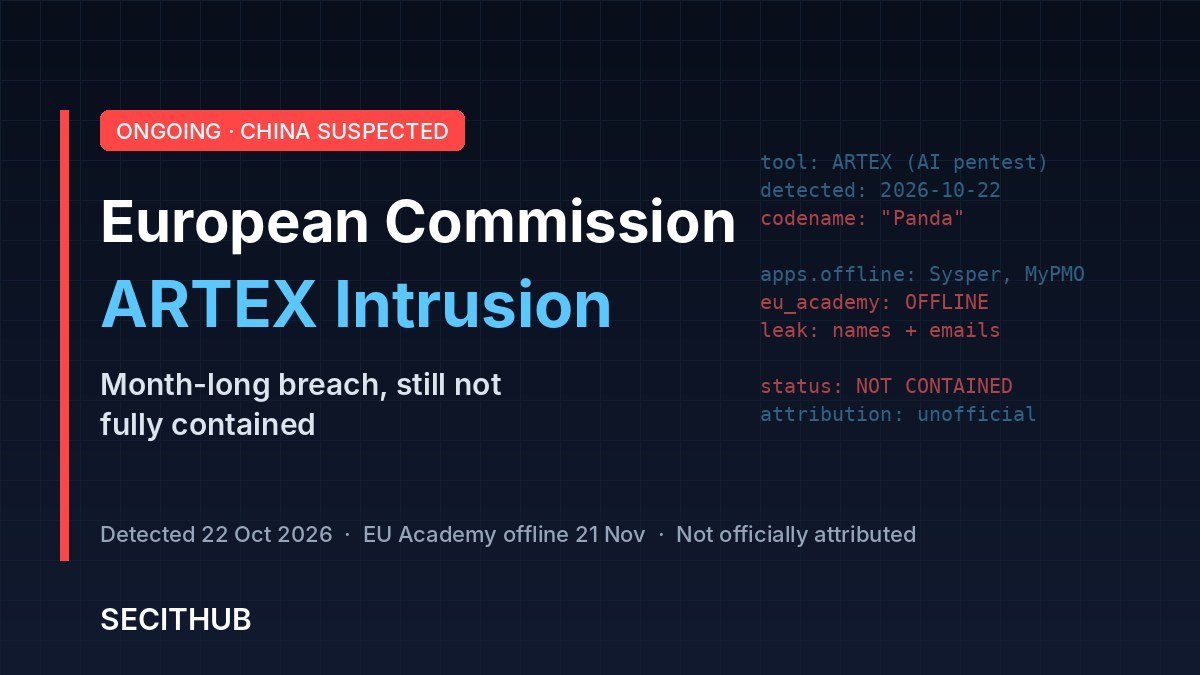
The European Commission cyberattack is now a month old and still not fully under control. On 23 November 2026, Euronews reported that the Commission suspects a China-backed network of threat actors, internally codenamed “Panda.” According to two sources cited by Euronews, the suspicion rests on the attack’s sophistication and on the use of ARTEX, an AI-powered hacking framework.
The Commission has not publicly attributed the attack. But the new details change the story. What was first described as a disruptive “AI-generated cyber campaign” now looks like a persistent intrusion into the EU’s executive.
What Is New in the European Commission Cyberattack
A Suspected China-Backed Actor
Euronews reports that the Commission suspects a China-backed network. It is not naming a specific group. A threat assessment cited by Euronews suggests the attacker was not chasing particular systems or people. Instead, it appeared to be testing how deep it could get into the Commission’s networks.
Still Not Contained
The Commission’s IT department detected the attacker on 22 October. According to Euronews, the EU executive has not yet fully contained the breach. On Saturday, 21 November, it took the EU Academy website offline. Several internal apps were also disabled as a precaution, and some remain down.
EU Academy User Data Leaked
The Commission has confirmed a leak of names and email addresses of EU Academy users, according to Euronews. It warns users about possible phishing based on that data. EU Academy is the Commission’s online learning platform. For other systems, experts have not confirmed any theft of Commission staff data.
A disruption is a headline. A month-long presence is an intrusion.
What We Know and What Is Still Unclear
- The Commission detected the intrusion on 22 October
- It confirmed an “AI generated cyber campaign” on 19 November
- Several staff apps were taken offline
- EU Academy user names and emails leaked
- Official attribution to China or any group
- How the attackers first got in
- Whether staff HR or medical data was taken
- When the intrusion will be fully contained
What the Commission Said Last Week
On 19 November, Commission spokesperson Thomas Regnier confirmed the attack at the midday briefing. He called it a “misuse of an AI tool” that is publicly available. He said several applications were taken down and most were restored. He also said the Commission had found no evidence of a data breach affecting staff as a whole. He declined to name the attacker and said he was not aware of any ransom demand.
The Staff Systems Hit
POLITICO first reported the incident. Its reporting, as summarized by Cyber Security News, says Sysper went down. Staff use it for payslips, working hours and leave. MyPMO, which handles medical reimbursements, was also affected, and translation services were disrupted on 17 November. The Commission has not confirmed that payslip, leave or medical data was exposed.
ARTEX: The AI Tool Behind the Campaign
A Pentest Tool Turned Weapon
CERT-EU describes ARTEX as an AI-powered penetration testing framework that finds weaknesses in IT systems. According to Dark Reading, an independent developer published it on GitHub in July as a legitimate open-source tool. The developer deleted the original repository at the end of October because of abuse, but many forks remain. Euronews describes ARTEX as Chinese-developed. Its exact origin matters less than the fact that anyone can still get a copy.
Other ARTEX Campaigns
Researchers have tied ARTEX to several China-linked operations this autumn. Microsoft linked it to a group it tracks as Storm-0940. CrowdStrike reported that a group it calls VAPOR PANDA used ARTEX from 17 October against more than 200 organizations, including foreign ministries. Euronews mentions these groups only as context. No public report ties either one to the Commission attack.
Why AI Changes the Math
Tools like ARTEX chain reconnaissance, vulnerability discovery and exploitation at machine speed. That lets one operator probe many targets at once. It also fits the Euronews description of an attacker testing how far it could go. We covered the same shift in our report on the first fully automated AI cyberattack and in our analysis of AI-powered malware.
The tool was built to find weaknesses. It still does. It just works for whoever runs it.
Why the Silence Is Drawing Criticism
The Commission has shared few details. An official told Euronews that public communication is not planned in cases like this, since it could alert the attacker that mitigation is under way. The main staff union disagreed and criticized management for letting staff learn about the incident from the press. China has consistently denied sponsoring hacking groups that target foreign governments.
Both sides have a point. Quiet containment can stop an attacker from digging in deeper. But staff whose data may be at risk need enough information to spot phishing. The same tension appeared in the Austrian Foreign Ministry hack this month.
Lessons From the European Commission Cyberattack
Public bodies and large enterprises face the same AI-driven tools. Start with these steps:
- Assume faster attacks. AI frameworks can go from scanning to exploitation quickly. Shorten your patch windows for internet-facing systems.
- Hunt for machine-speed scanning. Look for bursts of automated probing across many apps from the same source.
- Watch side doors. Training portals, HR apps and other low-profile systems can expose data and give attackers a foothold.
- Warn exposed users fast. When contact data leaks, tell users to expect phishing that uses your brand.
- Use phishing-resistant MFA. It limits the damage when staff or users fall for a lure.
- Plan internal communication. Decide in advance what staff will hear and when, even during a quiet containment.
The European Commission cyberattack is still developing. Watch for official attribution, a statement on staff data, and confirmation that the intrusion is contained. For tools that cover detection and response, see our Cybersecurity Vendor Landscape.
When attackers automate, defenders cannot wait for office hours.

Attackers have been active in European Commission networks since at least 22 October 2026, using the AI tool ARTEX. Several staff applications were taken offline, and the EU Academy website went offline on 21 November.
Euronews reports that the Commission suspects a China-backed network, citing two sources. The Commission has not publicly attributed the attack, and China denies sponsoring such hacking.
ARTEX is an AI-powered penetration testing framework. It was published as open source in July 2026 and later abused by several threat groups. The original repository was deleted, but forks remain available.
The Commission has confirmed a leak of names and email addresses of EU Academy users. It has not confirmed theft of Commission staff data from other systems.
Not fully. Euronews reports the breach has not been fully contained a month after detection. The Commission says many elements have been contained.
Expect phishing emails that use their name and the EU Academy brand. They should not click unexpected links, should log in only through the official site and should use strong, unique passwords.
Sources
Euronews: China-backed hackers suspected behind ongoing EU Commission cyberattack
Help Net Security: European Commission confirms AI-generated cyberattack
Cyber Security News: Hackers target European Commission with ARTEX AI tool
Dark Reading: Artex, the AI pen-test tool hackers turned into a weapon