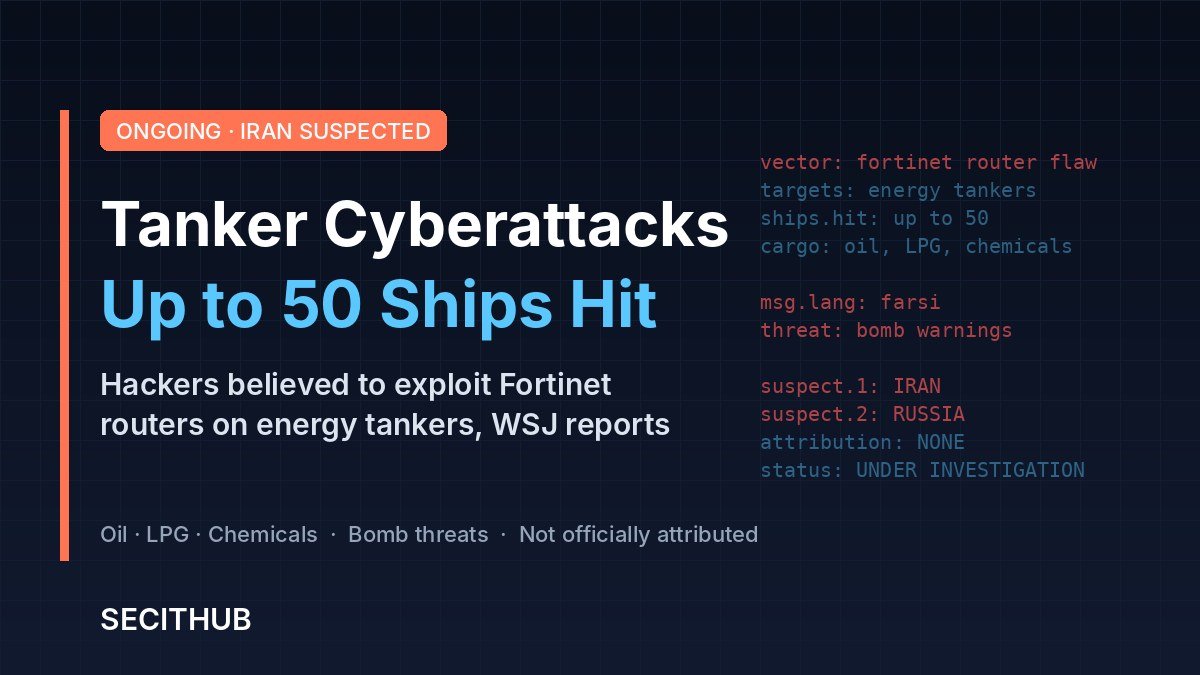
The tanker cyberattacks that began with two Texas-bound ships in August now look like a campaign. On 23 November 2026, The Wall Street Journal reported that the United States is investigating whether Iran is behind cyberattacks on as many as 50 ships carrying oil, liquefied petroleum gas, chemicals and other explosive cargo. Some crews also received bomb threats warning that their vessels could be blown up.
According to the Journal, as relayed by Reuters and i24NEWS, US officials see Iran as the primary suspect and Russia as another possible culprit. The attackers are believed to be exploiting a flaw in Fortinet routers that are widely used across shipping. Reuters said it could not immediately verify the report, and a Trump administration official said there is no evidence of Iranian involvement.
What Is New in the Tanker Cyberattacks
From Two Ships to Up to 50
Until now, the public story was about two tankers. The new report puts the number at up to 50 vessels, all carrying hazardous cargo. The WSJ cites US officials and others familiar with the matter. It does not name the ships, their operators or their routes, and it gives no dates for most of the incidents.
Bomb Threats and Messages in Farsi
This is what turns the story from IT incidents into a pressure campaign. Some vessels received bomb threats. According to i24NEWS’s summary of the WSJ report, some also received messages in Farsi warning them not to load American products. The report also says US Coast Guard cyber teams boarded at least four ships before they reached American ports.
A Suspected Fortinet Entry Point
The WSJ report points to a flaw in Fortinet routers as the way in. It does not name a CVE, a product model or a firmware version. That matches an earlier warning. On 4 September 2026, the Coast Guard and FBI issued a joint Maritime Cyber Alert saying nation-state actors were exploiting Fortinet FortiGate devices on vessels and port facilities. We do not yet know whether the flaw in the new report is one of the issues named in that alert.
A tanker carries explosive cargo. Its firewall is now part of the safety system.
What We Know and What Is Still Unclear
- The Coast Guard and FBI boarded two hacked tankers in August
- The Coast Guard confirmed malicious cyber activity on the VL Prosperity
- A joint alert warned of nation-state attacks on Fortinet devices in shipping
- The US is investigating a wider wave, according to the WSJ
- Official attribution to Iran, Russia or anyone else
- The exact number of ships hit
- Which Fortinet flaw was used
- Whether any ship lost control of critical systems
The August Boardings
The first public cases surfaced in September. Specialized Coast Guard cyber teams and FBI agents boarded two Texas-bound tankers, the VL Prosperity and the Kohaku, on 21 and 24 August. Both had transited the Strait of Gibraltar. The Coast Guard confirmed evidence of malicious cyber activity on the VL Prosperity but did not attribute it to Iran. US authorities said at the time that there were no reports of operational disruptions, vessel instability, danger to crew or environmental damage.
A Third Tanker and 20 Ships Watched
In mid-September, Bloomberg reported that a third tanker crossing the Mediterranean toward Italy suffered control system failures that its crew suspected were caused by a cyberattack. Cybernews reported that US authorities were then monitoring nearly 20 ships worldwide, and that CISA said the attackers did not appear to have taken control of the affected vessels. The Coast Guard also began asking vessel operators to report suspected incidents.
The Counterpoint From Washington
Not everyone in the administration sees an Iranian campaign. A Trump administration official told the Journal there is no evidence of Iranian involvement and described four of the attacks as a minor nuisance. Separately, on 18 November, Homeland Security Secretary Markwayne Mullin said in written testimony that Iran and Tehran-backed actors have targeted US transportation, energy, financial, healthcare and water systems since the war began. Both statements can be true. Iran can be active in US networks without being proven responsible for these ships.
Why Fortinet Devices Sit at the Center
The Coast Guard and FBI Warning
The 4 September alert is the most concrete public guidance so far. It says nation-state actors are exploiting Fortinet FortiGate firewalls and VPN gateways used by vessels and facilities in the Marine Transportation System. It names two vulnerabilities to fix first: CVE-2026-24858, a FortiCloud single sign-on authentication bypass that CISA added to its KEV catalog in January, and CVE-2025-25252, an SSL VPN session flaw. It also warns that attackers move laterally, escalate privileges and establish persistence once inside.
FortiBleed Made It Easier
Not every break-in needs a new vulnerability. The same alert cites FortiBleed, a credential leak with no CVE. CISA estimates that credentials for 74,000 Fortinet devices were compromised and leaked. Maritime security firm Cydome said more than 250 maritime firms were affected. It also found that 87% of exposed Fortinet devices still had management interfaces reachable from the internet, and that 63% of the harvested credentials belonged to default or built-in admin accounts that were never renamed.
Why Ships Are Hard to Defend
A tanker is a floating OT network. Navigation, engine control and cargo systems often run on old equipment that cannot be patched quickly, while satellite links connect the ship to its owner’s office. The firewall at that boundary is often the only control between the internet and the engine room. Shipping has also been a cyber battlefield before. In March 2025, a group calling itself Lab Dookhtegan claimed it disrupted communications on more than 100 Iranian oil tankers. We covered the wider problem in our guide to OT cybersecurity challenges and in our report on a state-backed group exploiting VPN flaws to reach OT networks.
At sea, a stolen admin password can travel farther than a missile.
The SECITHUB Take
Treat the attribution with care and the technical risk with urgency. The Iran link rests on anonymous officials, and another official publicly disputes it. But the entry point is not in dispute. Federal agencies have warned for months that internet-facing Fortinet devices on ships are being hit, and leaked credentials make some of them easy targets. The bomb threats show the goal may be fear and delay, not damage. A crew that receives a threat after a cyber incident has to treat it seriously, and that alone can stop a ship. That makes basic edge hygiene a safety issue, not just an IT one.
What Ship Operators Should Do About Tanker Cyberattacks
These steps follow the Coast Guard and FBI alert and apply to any fleet or port running Fortinet or other edge devices:
- Patch the named flaws first. Fix CVE-2026-24858 and CVE-2025-25252, then bring every FortiGate on board and ashore to a supported release.
- Reset admin credentials. Assume FortiBleed exposed them. Rename or disable default admin accounts and use strong, unique passwords.
- Take management off the internet. Admin interfaces should be reachable only from a trusted management network.
- Enforce MFA. Require it for every VPN profile and admin portal.
- Segment IT from OT. Navigation, propulsion and cargo systems should never sit on the same flat network as crew Wi-Fi or office links.
- Review logs and accounts. Look for unknown admin accounts, new VPN users and firewall rule changes.
- Replace end-of-life devices. Unsupported firewalls carry frequently exploited risk.
- Report incidents fast. In the US, report maritime cyber incidents to the National Response Center at 1-800-424-8802.
For help choosing and hardening edge devices, see our best SMB firewalls guide and our Zero Trust Access Guide. Watch for official attribution, the name of the Fortinet flaw and any confirmation that a ship lost control of its systems.
Attribution can wait for evidence. Patching cannot.

A wave of cyberattacks on ships carrying oil, LPG, chemicals and other explosive cargo. The Wall Street Journal reports that up to 50 vessels may have been hit, and that some crews also received bomb threats.
Not confirmed. US officials cited by the WSJ see Iran as the primary suspect and Russia as another possible culprit. A Trump administration official said there is no evidence of Iranian involvement.
According to the WSJ report, the attackers are believed to exploit a flaw in Fortinet routers widely used in shipping. The report does not name the flaw. A September Coast Guard and FBI alert named CVE-2026-24858 and CVE-2025-25252 and the FortiBleed credential leak as key risks.
That has not been confirmed. After the August incidents, US authorities reported no operational disruptions, and CISA said attackers did not appear to take control of the vessels. A third tanker reported control system failures in September.
FortiBleed is a large leak of Fortinet device credentials that surfaced in June 2026. It has no CVE. CISA estimates that credentials for 74,000 Fortinet devices were compromised and leaked.
Patch Fortinet devices, reset admin credentials, remove management interfaces from the internet, enforce MFA, segment IT from OT and report incidents. In the US, maritime cyber incidents go to the National Response Center at 1-800-424-8802.
Sources
US Coast Guard and FBI: Maritime Cyber Alert 02-26, Fortinet FortiGate Vulnerabilities
NVD: CVE-2026-24858
NVD: CVE-2025-25252
gCaptain: U.S. probes suspected Iranian cyberattacks on up to 50 ships
i24NEWS: US investigating possible Iranian role in cyberattacks on up to 50 tankers
Cybernews: Suspected cyberattack on third tanker, US monitoring 20 ships
Bloomberg Government: Iran hit key infrastructure, US says
Hellenic Shipping News: Global maritime under threat from FortiBleed, warns Cydome