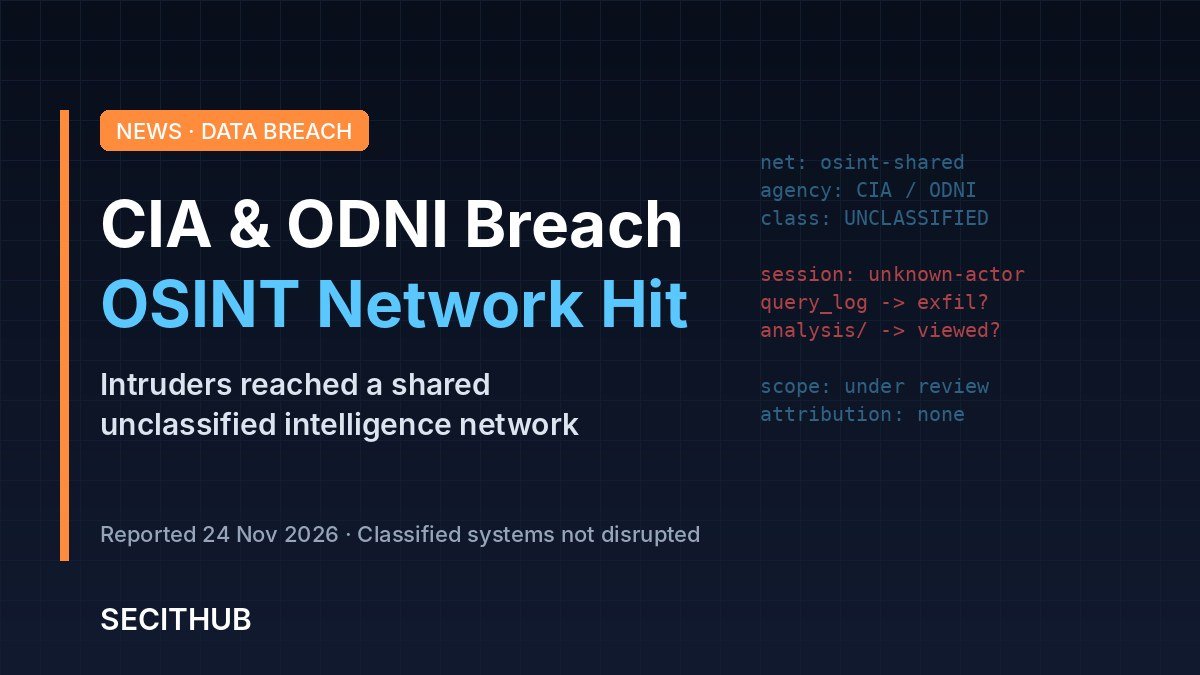
The CIA ODNI breach shows that “unclassified” does not mean “unimportant.” The CIA and the Office of the Director of National Intelligence recently discovered intruders on a network that exposed some of their unclassified information. The New York Times first reported the breach on 24 November, and Reuters and CNN followed.
What Happened in the CIA ODNI Breach
The intrusion hit a shared network that looks for intelligence insights in public, unclassified material. This is the world of open-source intelligence (OSINT): news, research, social media and commercial data that analysts collect and study.
According to the Times, information at other government agencies was also believed to be exposed. Cyber Security News, citing the Times, says the National Geospatial-Intelligence Agency was among them. Officials have not confirmed that publicly.
ODNI told CNN there had been “no disruptions to critical capabilities or classified systems.” A CIA official told the Washington Examiner that the network was disrupted and the issue has been resolved.
- Intruders reached a shared OSINT network
- Some unclassified information was exposed
- ODNI says classified systems were not disrupted
- The CIA says the issue is resolved
- How the intruders got in
- How long they had access
- Which files or analysis they saw
- Who is behind the attack
Why an Unclassified Network Still Matters
The public sources themselves are not secret. What analysts do with them is. Search queries, collected material and analysis notes can reveal which people, countries and topics the intelligence community is watching. That is valuable to any foreign service.
The key open question is whether the intruders saw only source material or also the internal analysis built on top of it. Restoring a network and proving what was viewed or copied are two separate jobs.
Public data is not secret. What you choose to study is.
The breach lands in a run of US government incidents. We covered the FBI NCIC breach earlier this month, and Reuters notes recent incidents at the Pentagon and the Department of Homeland Security. No public evidence links any of them to this breach.
What Security Teams Should Take From It
Most organizations have their own version of this network: a research tenant, a data lake or an analytics platform that is “only internal” or “only public data.” Start here:
- Classify by what it reveals. Judge a system by what its queries and outputs expose, not by where the raw data came from.
- Monitor it like production. Send logs from research and analytics platforms to your SIEM and keep enough history to scope an incident.
- Limit shared access. Shared networks across teams or agencies need separate identities, least privilege and MFA.
- Plan the scoping step. Know in advance how you would prove what an intruder viewed or copied.
We will update this story when officials say how the intruders got in and who is behind it.

Intruders reached a shared CIA and ODNI network used to analyze public, open-source material and exposed some unclassified information. The New York Times first reported it on 24 November 2026.
ODNI says there were no disruptions to critical capabilities or classified systems. Officials have not said exactly which unclassified files were exposed.
No one has been publicly named. US officials have not attributed the breach to any person, group or government.
The sources are public, but the queries, collections and analysis can reveal what the intelligence community is watching. That is valuable to foreign intelligence services.
Sources
Reuters (via U.S. News): US CIA, ODNI suffer cybersecurity breach of some unclassified information
Cyber Security News: CIA and ODNI reportedly suffer cyberattack
Washington Times: Hackers breach intelligence website used by CIA (July 2025)